
The Best Six Sigma Yellow Belt training doesn’t just give you a certification—it equips you with real knowledge and practical skills that employers actually value. Hiring managers rarely ask how long you studied for an exam; they focus on what you can do—for entry-level candidates, that means demonstrating knowledge, and for experienced professionals, it’s about hands-on experience: the projects you’ve completed, problems you’ve solved, and tools you’ve applied in real situations (read more in our detailed discussion of Six Sigma certification and practical experience).
Certification alone isn’t a guarantee of competence. If your experience is limited and your certification is based on minimal study, the gap becomes obvious. Yet certifications can still add value—helping self-learners deepen knowledge, validating practical skills, or boosting credibility in roles where Six Sigma is only part of the work.
Comparison Table: Best Six Sigma Yellow Belt Trainings with Certification
In this article, we’ll cover three Yellow Belt training paths with certification:
| Program / Course | Yellow Belt Lean Six Sigma program from the Technical University of Munich | GLSS Lean Six Sigma Yellow Belt Training & Certification | Yellow Belt Lean Six Sigma program from ISCEA |
|---|---|---|---|
| Validity | Does not expire | Recertification needed every 2 years | Recertification needed every 3 years |
| Total Cost | $546.30 | $99.00 | $564.30 |
| Self-paced | Yes | Yes | No (prepatory courses self-paced not the last course) |
| Certification type | University certification | Independent provider | Independent provider |
| Duration | 88 hours | 2 hours | 30 hours |
| Best fit for | Achieving in-depth knowledge and hands-on skills for a strong foundation with recognition | Earning recognition quickly | Pre-career or early-career Supply Chain professionals |
Best Lean Six Sigma Yellow Belt Certification for a Solid Foundation and Recognition
Comprehensive training with certification from the Technical University of Munich via edX
| Program | Validity | Total Cost | Self-paced | Certification type | Duration | Prerequisites |
|---|---|---|---|---|---|---|
| Lean Six Sigma Yellow Belt program from TUM | Does not expire | $546.30 (training + certification) | Yes | University certification | 88 hours | No |
Program Structure
The Yellow Belt program is offered on the edX platform and consists of three courses:

Six Sigma Part 1
(105 reviews as of January 19, 2026)
- Introduction: Motorola’s Six Sigma
- Define: Understanding Customer Expectations
- Measure: Statistics Review
- Measure: The Normal Distribution
- Measure: Process Mapping
- Measure: Measurement System Analysis
- Measure: Process Capability
- Quality Topics and Course Summary

Six Sigma Part 2
(52 reviews as of January 19, 2026)
- Analyse: Root Cause Analysis
- Analyse: Inferential Statistics
- Improve: Design of Experiments
- Control: SPC and Control Charts
- Improve: Analysis of Variance
- Control: Other Control Charts
- Quality Tools and Design for Six Sigma (DFSS)
- Code of Ethics and Course Summary

Lean Production
(92 reviews as of January 19, 2026)
- Introduction: Identification of Waste
- Understanding Flow: Capacity Analysis
- Continuous Flow: Setup Time Reduction
- Improving Flow: Workplace Organization and Visualization
- Maintaining Flow: Establishing Pull-Systems and Scheduling
- Quality and Continuous Improvement
Program Certificates
After successfully completing all three courses, you will receive:
- An edX Verified Certificate for each individual course
- An edX Professional Certificate for the full program
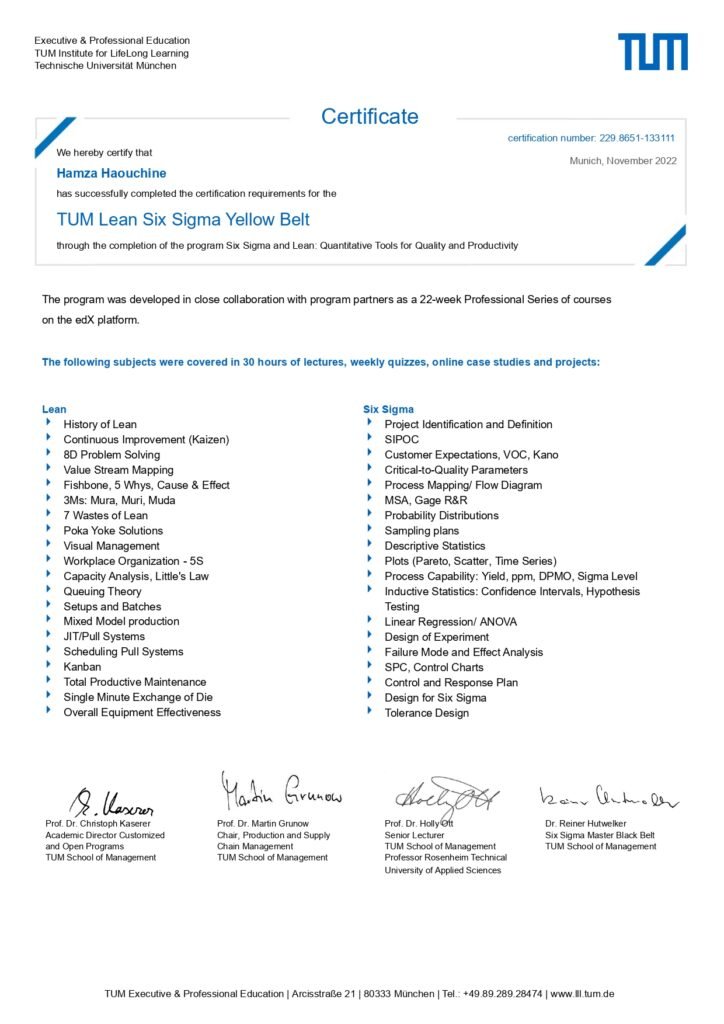
- The TUM Lean Six Sigma Yellow Belt certification document (see my certificate below)
Pros:
- Highly recognized: The program is offered by the Technical University of Munich (TUM), a prestigious and well-respected institution
- Program aligns with the ASQ Green Belt Body of Knowledge
- The main instructor, Professor Holly Ott, is responsive and helpful; the special guest, Mr. Zubair Anwar, is an ASQ Fellow and ASQ Black Belt
- Very rich curriculum (30 hours of lectures)
- Practical examples and case studies from successful German Mittelstand manufacturers (small- to medium-sized, proven successful), rather than hypothetical or large-company examples
- Lean Production is taught separately from Six Sigma, which helps clarify concepts and gives Lean its due focus
Cons:
- Time-intensive program to achieve certification
Best Lean Six Sigma Yellow Belt Certification for Quick Recognition
The GLSS program offers light training with certification
| Program | Validity | Total Cost | Self-paced | Certification type | Duration | Prerequisites |
|---|---|---|---|---|---|---|
| Lean Six Sigma Yellow Belt program from GLSS | Recertification needed every 2 years | $99.00 (training + certification) | Yes | Independent provider | 2 hours | No |
Course Structure
The course is organized into six modules, covering the DMAIC phases and integrating Lean tools:
- Problems
- Processes
- Lean Six Sigma
- Lean Six Sigma Belt Levels
- Project Charter
- Process Map
- Process Walk
- Loopbacks
- 8 Wastes
- Root Causes
- 5 Whys
- 5S
- Quick Wins
- Solution Implementation Plan
- Standard Operating Procedure
- Visual Management
- Project Handoff
- Project Summary
Note: Completing a Yellow Belt Project is optional.
Course Certificate
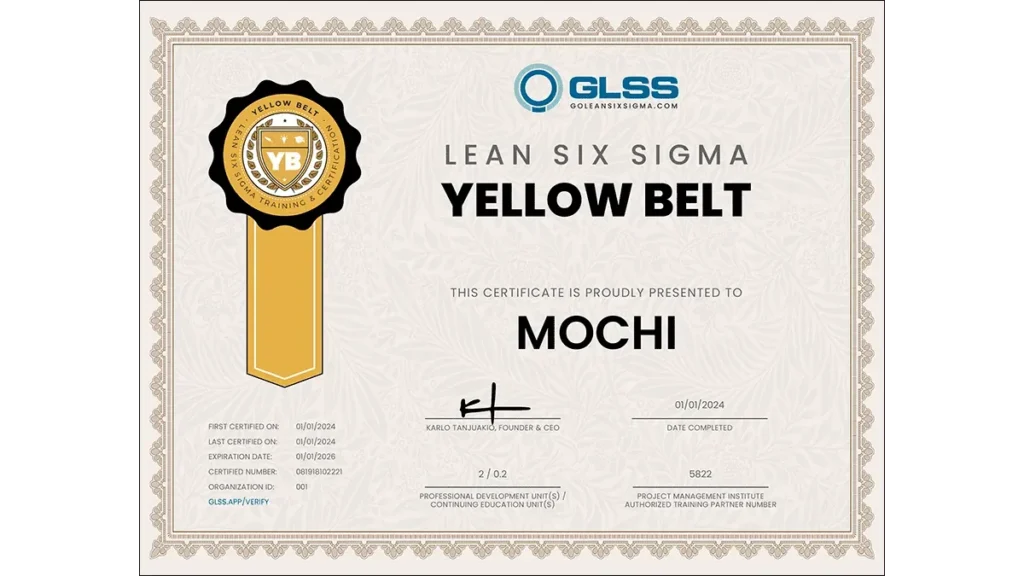
Upon completing the course, you’ll receive the following certification document:
Pros:
- Fast certification
- Practical, illustrated examples
- Very affordable
- Recognized by many tech companies
- Excellent user interface
- Earn 2 PDUs (Professional Development Units) – continuing education credits required by PMI to maintain certifications like the PMP
Cons:
- Light curriculum – can be supplemented with our recommended books
- Requires recertification every 2 years
Best Lean Six Sigma Yellow Belt Certification for Supply Chain Professionals
Ideal for supply chain professionals, offered by the International Supply Chain Education Alliance (ISCEA) via edX
| Program | Validity | Total Cost | Self-paced | Certification type | Duration | Prerequisites |
|---|---|---|---|---|---|---|
| Lean Six Sigma Yellow Belt program from ISCEA | Does not expire | $395.00 (training + certification) | Yes | Independent provider | 30 hours | No |
Program Structure
The Certified Lean Six Sigma Yellow Belt program is offered on edX and consists of two preparatory courses, followed by a third course containing the exam:

Introduction to Lean Six Sigma For sustainable and resilient supply chains
(11 reviews as of January 20, 2026)
1- Introduction to Lean Six Sigma for Supply Chains
- Brief History and Overview of Six Sigma
- How Six Sigma Began
- Quality Gurus
- A Brief History and Overview of Lean
2- DMAIC
- MAIC to DMAIC Methodology
- Comparison to Other Quality Initiatives
- What Is Six Sigma, Mathematically
- DMAIC Tools
- The Lean In Six Sigma
3- Roles and Responsibilities
- Expert Roles
- Empowering Six Sigma

Lean Six Sigma Program and Project Management
(13 reviews as of January 20, 2026)
1- Lean Six Sigma-SC, Company Perspectives and Business Justifications
- Enterprise Wide Deployment
- The Company Perspective
- Define (Sponsorship)
- How to Invest In Six Sigma
- Empowering The Rest of The Yellow Belts
- When The Specialist Leaves
2- LSS-SC, Steps to Project Management
- Define (Yellow Belt)
- Know Which Job You Are Doing
- Measure
3- How to Manage Six Sigma
- Analyze/Improve
- Empowering for Low Hanging Fruit
4- LSS-SC, Steps to Maintain Success and Preventing Problems
- Control, – How We Use Tools Like Statistical Process Control to Identify Real Problems
- Lean as an Execution Tool for Getting a Process Back Into Control Quickly

ISCEA CLSSYB Exam
(0 reviews as of January 20, 2026)
This third course includes the official CLSSYB certification exam, taken online with remote proctoring via Proctortrack.
Candidates must first complete an included onboarding exam. The certification exam has 50 multiple-choice questions, a 2-hour time limit, and requires a minimum score of 70% to pass.
Program Certificates
After successfully completing all three courses, you will receive:
- An edX Verified Certificate for each individual course
- An edX Professional Certificate for the full program
- The ISCEA Certified Lean Six Sigma Yellow Belt Certificate
Pros:
- Supply-chain oriented – recommended for pre-career or early-career supply chain professionals
- Rich curriculum – 28 hours dedicated to exam preparation
- Practical examples – focused on supply chain applications
Cons:
- Proctored final exam – not self-paced; preparatory courses, however, are self-paced
- Requires recertification every 3 years
- Limited reviews on edX to date
Final Thoughts
The best Six Sigma Yellow Belt training depends on your career objectives and the level of knowledge you want to achieve:
- For beginners in quality engineering or anyone looking to build a solid foundation, a long and comprehensive program is the best option.
- For experienced professionals seeking formal certification, a fast program is ideal.
- For early-career supply chain professionals, a comprehensive, supply-chain-oriented program is the top choice.
Good luck!
Take the next step toward your Green Belt certification
Compare our best-selected Lean Six Sigma Green Belt training programs.