
It can be confusing for professionals trying to determine which Six Sigma certification is most recognized. Many also ask, “Is CSSC Six Sigma recognized?” as they compare the credibility of different certification providers.
For many other certifications, the path is straightforward: a single accreditation framework exists, certification bodies are accredited by the same authority, and as a result, curricula, training duration, and costs fall within a relatively narrow and predictable range.
Six Sigma is different.
There is no single governing body or universal accreditation framework for Six Sigma. Instead, the market is fragmented, with multiple providers, methodologies, and certification standards coexisting. This makes the landscape feel like a maze for professionals who are trying to choose the “right” certification.
I’ve successfully navigated this complexity, and in this guide, I’ll help you understand which Six Sigma certifications are most recognized—and, more importantly, what you need to know before selecting a certification provider.
In this guide, you’ll learn:
The Three Types of Six Sigma Certification Providers
Three main types of providers offer Six Sigma certification:
1. Accredited Six Sigma Certifications
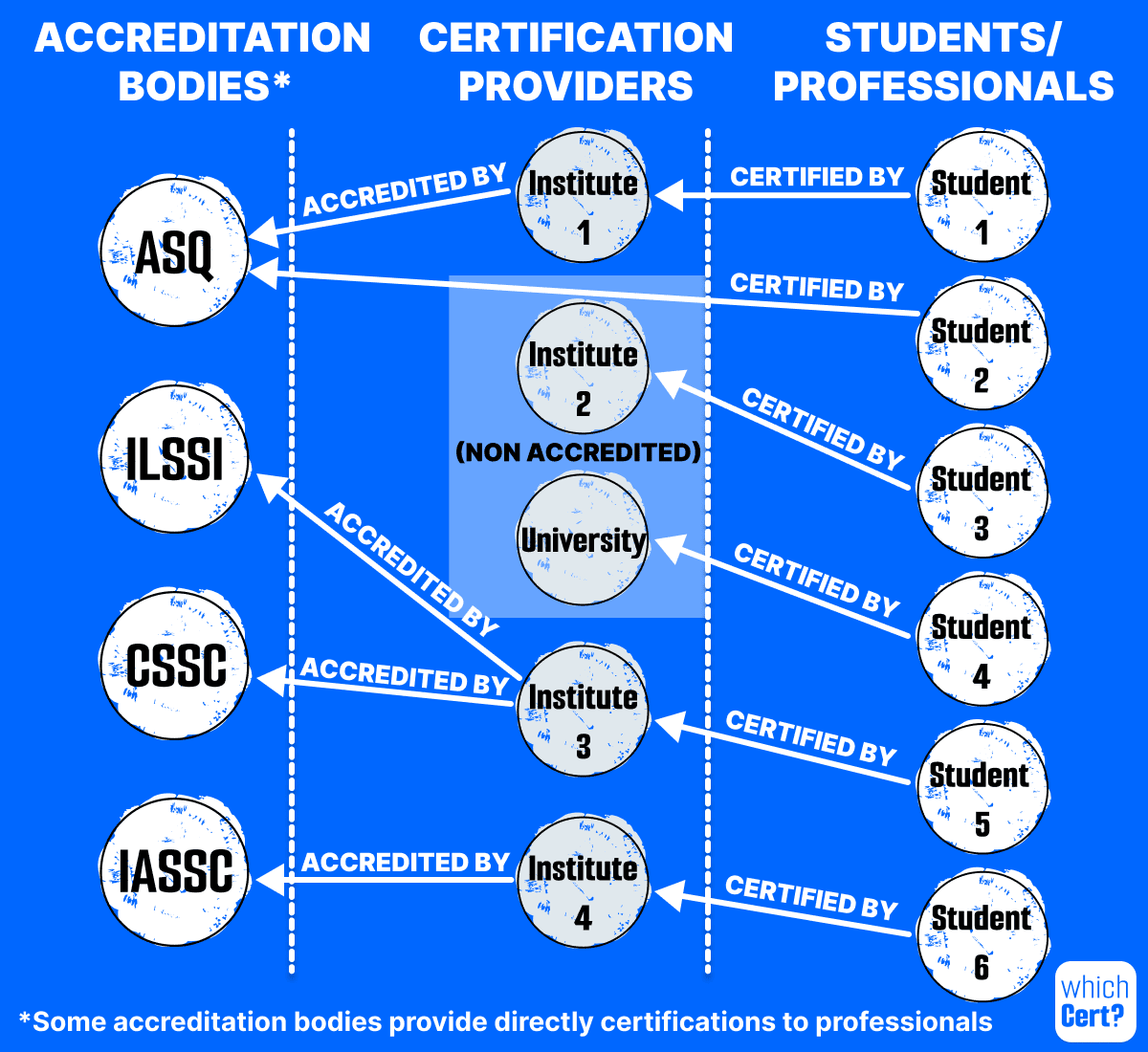
Accredited certification providers are usually recognized by one of these bodies:
- ASQ (American Society for Quality)
- ILSSI (International Lean Six Sigma Institute)
- IASSC (International Association for Six Sigma Certification)
- CSSC (Council for Six Sigma Certification)
Accredited Six Sigma certifications are built on a clearly defined body of knowledge, which provides transparency regarding the concepts, tools, and methods assessed during the examination.
An accreditation body is an organization responsible for evaluating and approving certification providers to ensure that they comply with defined quality and governance standards.
It is important to distinguish accreditation bodies from certification providers, even though some accreditation bodies also issue certifications directly.
For this reason, when comparing certifications on WhichCert.com, it is important to pay attention to the wording we use.
“Certification providers accredited by ILSSI” ≠ “Certification offered by ILSSI”
Generally, accredited certification providers follow certification criteria that are closely aligned with those of their accreditation body. For example, if the accreditation body offers certifications without requiring a project submission, its accredited providers will usually follow the same approach. However, there are exceptions, as some certification providers choose to apply stricter requirements than the accreditation body itself.
Even when the Body of Knowledge is aligned, the certification provider may still have a different certification process, exam structure, project requirements, training approach, support, and overall certification experience than the accreditation body itself.
Still confused about accreditation? Read our clear explanation and make sense of it.
Those accreditation bodies (ASQ, ILSSI, CSSC, and IASSC) publish formal bodies of knowledge that define the exam scope and outline the knowledge and skills expected from certified professionals.
While ASQ and CSSC also provide official study materials, including exam guides and reference books, ILSSI recommends a third-party handbook, and IASSC does not publish nor reccomend an official handbook, requiring candidates who choose self-study to look for suitable third-party resources aligned with their body of knowledge.
For candidates planning to prepare independently, a curated overview of official ASQ and CSSC publications, along with recommended books aligned with ILSSI and IASSC requirements, can be found in this Six Sigma self-study book guide.
1.1. What are the Accredited Lean Six Sigma Certification Requirements?
Which Six Sigma belt levels usually require a project? Project requirements vary by certification provider and belt level. Green Belt and Black Belt programs are more likely to include a required project, but a project is not universally required for either level.
| Accreditation | Yellow Belt | Green Belt | Black Belt | Master Black Belt |
|---|---|---|---|---|
| ASQ | • Pass exam |
• Pass exam • 3 years of relevant experience |
• Pass exam • 3 years’ experience & 1 project (affidavit) or • 2 projects (affidavits) |
• ASQ Black Belt required • Portfolio review • 5+ years relevant experience or • 10 projects |
| ILSSI | • Pass exam | • Pass exam | • Pass exam |
• Black Belt (3+ years) • 3 projects • Reference required • Pass exam |
| IASSC | • Pass exam | • Pass exam | • Pass exam | • Not offered |
| CSSC | • Pass exam | • Pass exam |
• Pass exam • Green Belt Level II required |
• Pass exam + project • Black Belt Level III required |
1.2. How Long Does it Take to Get an Accredited Lean Six Sigma Certification?
| Accreditation | Yellow Belt | Green Belt | Black Belt | Master Black Belt |
|---|---|---|---|---|
| ASQ (ASQ self-paced option) | 8 + 2.5 hours | 42 + 4.5 hours | 55 + 4.5 hours | Varies |
|
ILSSI
(preparation training by RPM-Academy) | 18 + 1 hour | 44 + 2 hours | 60 + 3 hours | Varies |
| IASSC | 18 hours | 83 hours | 124 hours | Not available |
| CSSC | 20 hours | 35 hours | 95 hours | Varies |
Note:
Time to Get Certified has two Formats on WhichCert.com:
XX hours/weeks/months = Estimated total duration, excluding experience, projects, and prerequisite certifications.
XX + YY hours/weeks/months = XX hours/ of training/study + YY hours of exam time, excluding experience, projects, and prerequisite certifications.
1.3. How Long Does Accredited Lean Six Sigma Certification Last?
| Accreditation | Yellow Belt | Green Belt | Black Belt | Master Black Belt |
|---|---|---|---|---|
| ASQ | Does not expire | Does not expire | Recertification every 3 years | Recertification every 3 years |
| ILSSI | Does not expire | Does not expire | Does not expire | Does not expire |
| IASSC | Recertification every 3 years | Recertification every 3 years | Recertification every 3 years | Not available |
| CSSC | Does not expire | Does not expire | Does not expire | Does not expire |
Avoid hidden fees — see the full Six Sigma certification cost guide
2. Independent Six Sigma Certifications (Not Accredited)
Independent Six Sigma providers consistently emphasize that there is no single official authority governing Six Sigma. Neither Motorola, which developed the methodology, nor General Electric (GE), which played a major role in popularizing it, ever claimed such a position. From its origins, Six Sigma has functioned as an open framework shaped and shared by practitioners, rather than a system owned or controlled by a single organization.
As a consequence, certifications issued by independent providers are not aligned with a standardized body of knowledge. Their curricula, assessment methods, and levels of recognition therefore vary significantly. Most independent providers require candidates to complete their training and examinations, as self-study is difficult without a clearly defined BoK. The practical value of these certifications depends largely on the provider’s institutional background and the professional credibility of the Master Black Belts responsible for their design and delivery.
Note:
Some providers mention accreditation (PMI, BBB, etc.), which is real, but it does not apply to the Six Sigma certification they are offering.
2.1. What are the Independent Lean Six Sigma Certification Requirements?
| Belts Colors | Yellow Belt | Green Belt | Black Belt | Master Black Belt |
|---|---|---|---|---|
| Certification Requirements |
E.g. MSI: • Pass exam |
E.g. GLSS: • Training + Pass exam |
E.g. Juran: • Training + Pass exam • Project required for certification |
E.g. SSGI: • Black Belt required • Recommended: 5+ years’ experience • Complete Training • Submit Project • Pass exam |
2.2. How Long Does it Take to Get an Independent Lean Six Sigma Certification?
| Provider | Yellow Belt | Green Belt | Black Belt | Master Black Belt |
|---|---|---|---|---|
| GLSS | 2 hours | 4 hours | 8 hours | Not available |
| MSI | 1–4 Weeks | 2–4 Weeks | 4–8 Weeks | 8–12 Weeks |
2.3. How Long Does Independent Lean Six Sigma Certification Last?
| Provider | Yellow Belt | Green Belt | Black Belt | Master Black Belt |
|---|---|---|---|---|
| GLSS | Does not expire | Does not expire | Does not expire | Not available |
| MSI | Does not expire | Does not expire | Does not expire | Does not expire |
For additional historical perspective, the video below features Steve Jobs discussing Dr. Joseph M. Juran, one of the pioneers of modern quality management, who influenced Toyota’s approach to quality. Dr. Juran later founded the Juran Institute, a respected organization that offers Six Sigma certification programs, despite not operating under a formal accreditation framework.
3. University Six Sigma Certification
Because Six Sigma operates as an open framework, many universities have developed and offer their own certification programs, often delivered online.
University-based Six Sigma certifications are generally more academic in nature and are typically structured as comprehensive programs that require a longer time commitment to complete. Recognition is largely derived from the reputation and academic standing of the university itself. In some cases, these programs are also aligned with, or accredited by (such as Purdue University by ILSSI), one or more Six Sigma accrediting bodies, which can further strengthen their recognition in professional and academic contexts.
3.1. What are the University Lean Six Sigma Certification Requirements?
| Belts Colors | Yellow Belt | Green Belt | Black Belt | Master Black Belt |
|---|---|---|---|---|
| Certification Requirements |
E.g. TUM: • Complete program (3 courses) |
E.g. TUM: • Yellow Belt required • Project completion |
E.g. Villanova, UNC Charlotte: • Advanced coursework • Pass exam + major project |
E.g. Villanova, UNC Charlotte: • Advanced coursework • Coaching + strategic project |
3.2. How Long Does it Take to Get University Lean Six Sigma Certification?
| Universities | Yellow Belt | Green Belt | Black Belt | Master Black Belt |
|---|---|---|---|---|
| Villanova (micro-course option) | Not available | 37.5 hours | 37.5 hours | 37.5 hours |
| Technical University of Munich (TUM) | 88 hours | 80 hours | Not available | Not available |
| UNC Charlotte | 7 hours | 5–8 weeks | 11–17 weeks | 5–8 weeks |
3.3. How Long Does University Lean Six Sigma Certification Last?
| Universities | Yellow Belt | Green Belt | Black Belt | Master Black Belt |
|---|---|---|---|---|
| Technical University of Munich (TUM) | Does not expire | Does not expire | Not available | Not available |
| Purdue University | Does not expire | Does not expire | Does not expire | Does not expire |
Is an In-house Certification from Corporations a Certification Type? (Six Sigma Belt vs Six Sigma Role)
Yes, but we don’t list it on WhichCert.com as a separate type because it is generally not publicly accessible.
We also prefer to define it as a Six Sigma role rather than just a certification level, because the role itself carries real professional responsibilities.
There is an important distinction between earning a certification and actually performing the role in the industry. For example, it is difficult to consider someone who obtained a “Black Belt” in just a few hours as fully prepared to lead DMAIC projects, apply advanced statistical methods, or mentor Green Belts in a professional environment.
In practice, experience matters a lot. Personally, I would trust a Yellow Belt who has participated in two real DMAIC projects more than someone holding a superficial Black Belt certification without practical understanding.
Want to see how a DMAIC project unfolds from start to finish? Explore this beginner-friendly manufacturing example.
Accredited vs Non-Accredited
When reviewing job postings, it is uncommon to see recruiters explicitly requesting a specific Six Sigma provider or accreditation body. Most listings mention “Six Sigma certification” without further qualification.
To better understand how this is perceived in practice, I conducted polls across seven LinkedIn groups focused on quality engineering and continuous improvement. The question was straightforward:
Do recruiters care about the accreditation of a candidate’s Six Sigma certification?
The results were revealing:
- Yes: 250 votes
- They don’t care: 200 votes
Notably, the number of respondents who believe recruiters do not care at all was unexpectedly high.
Several Six Sigma professionals engaged in the discussion by emphasizing the rigor of the ASQ certification process, particularly the difficulty of its examinations and the depth of preparation required. They contrasted this with independent certifications that can be obtained in only a few hours of preparation, arguing that the two are not comparable in rigor.
Beyond the certification process itself, professionals also tend to evaluate the activity and visibility of the organizations behind these credentials. ILSSI, for example, has developed an engaged international community and is among the few organizations actively competing with ASQ in organizing conferences and industry events.
At the same time, many quality professionals expressed the view that recruiters generally do not evaluate the accreditation behind a Six Sigma certification—and I tend to agree. Except for certain top-tier manufacturing organizations that employ highly specialized recruiters, most recruiters are generalists. In practice, the same recruiter may be hiring a sales executive, a warehouse manager, and a quality engineer within the same period.
This leads to a more relevant question: if recruiters often do not differentiate between certifications, do hiring managers—particularly those with quality or engineering backgrounds—take a different view?
In most cases, the answer is yes, unless both the hiring manager and the organization have a limited understanding of Six Sigma. The discussion during the job interview is unlikely to focus on how long you prepared for a Green Belt exam, as such a question would immediately raise concerns. Instead, hiring managers tend to probe your Six Sigma capabilities: for entry-level candidates, this means assessing the knowledge you have acquired, while for experienced professionals, the focus is on hands-on, practical experience—the projects you have completed, the problems you have solved, and the tools you have applied in real situations.
If you are both certified and experienced, the recognition level of your certification is unlikely to work against you. However, if you lack practical experience and rely solely on a certification obtained through minimal study, this gap becomes immediately apparent—and potentially critical.
Are shorter or less demanding certifications inherently useless?
They can be appropriate and effective in different situations, for example:
- If you are a disciplined self-learner, certification can support your knowledge acquisition through deeper study, such as reading foundational and advanced Six Sigma literature (for example, the recommended Six Sigma self-study books).
- If you have practical experience applying Six Sigma principles in real projects, certification can serve as a complement that validates your hands-on skills.
- If the role you are applying for is not heavily focused on Six Sigma, certification can enhance your credibility or set you apart, as your Six Sigma work may be limited or part-time within a team led by experienced practitioners.
In these contexts, certification serves as a complement to either knowledge or practical experience, rather than a substitute for them.
Want to get Six Sigma certified? Read our 5-step guide to learn how to earn your Six Sigma certification.
Which Six Sigma Certification is Most Recognized? The Conclusion
Six Sigma certification requirements and training durations vary widely across different types of providers—accredited bodies, independent organizations, and universities. It is possible to obtain a Black Belt certification in as little as eight hours, while some programs may require 80+ hours of study for a Yellow Belt, yet still present significant challenges in passing the exam.
For entry-level candidates, the focus should be on the knowledge acquired through training and study.
For experienced professionals, hands-on, practical experience with real Six Sigma projects is far more important. In both cases, certification can help open doors and secure interviews, but it is your knowledge or experience that will ultimately determine your effectiveness and credibility in the role.
Ready to start your Lean Six Sigma journey? Enroll in one of the best White Belt (free) certification programs, or explore our carefully selected Yellow Belt, Green Belt, and Black Belt certifications to continue advancing your career.
FAQ
Which Six Sigma Belt is Best?
There is no single best belt; it depends on the role. For part-time Six Sigma responsibilities, the Green Belt is usually sufficient, while full-time Six Sigma roles typically require a Black Belt. A detailed breakdown of responsibilities by belt level is available in this overview of Six Sigma team roles.
Which is Better, PMP or Six Sigma?
PMP focuses on project management, while Six Sigma focuses on quality and process improvement. They serve different purposes. PMP is often valuable for Six Sigma professionals because improvement work is project-based, but Six Sigma certification is not required for most PMP roles. See the full comparison between Lean Six Sigma and project management certifications like PMP, Agile, Scrum, and PRINCE2.
Is CSSC Six Sigma certification recognized?
CSSC is an accreditation body for Six Sigma certification. They are not the only one: ASQ, ILSSI, and IASSC are also accreditation bodies that provide accreditation to certification bodies, and at the same time they deliver the certification directly (students can go through either route). In the US, ASQ is largely more recognized, and globally ILSSI has better involvement in Lean Six Sigma than CSSC and IASSC.
Which Six Sigma belt levels usually require a project?
Green Belt and Black Belt certifications are the levels most likely to require a Six Sigma project, but requirements vary by provider. Some providers require a completed project, while others do not. See the certification requirements above for a provider-by-provider comparison.