
There are four Lean Six Sigma certification levels, commonly known as the “Six Sigma belts.” Each level is represented by a distinct belt color, symbolizing the practitioner’s expertise and role within a project:
- Six Sigma Yellow Belt: The most common introductory level (Level 1)
- Six Sigma Green Belt: Level 2
- Six Sigma Black Belt: Level 3
- Six Sigma Master Black Belt: Level 4
In this guide, you’ll learn:
What are the roles in a Six Sigma team?
The roles of Six Sigma professionals depend on their contribution to a Six Sigma project. The most common project framework is DMAIC (Define, Measure, Analyze, Improve, and Control), which includes five stages.
Here are the Six Sigma belts and the key non-Six Sigma roles that often join a DMAIC project:
| Role | Responsibilities |
|---|---|
| Yellow Belt | As team members, they have basic training in Six Sigma and understand quality. They contribute their expertise and support during DMAIC phases as needed. |
| Green Belt | They work part-time on DMAIC projects. They use Six Sigma tools in their daily tasks and lead smaller projects with support from Black Belts. |
| Black Belt | They lead DMAIC projects full-time. They use advanced tools, train Green Belts, and ensure project success. |
| Master Black Belt | These full-time experts manage DMAIC efforts. They train Black Belts and provide advanced guidance. |
| Executive Leaders | They show commitment from the top. They set a vision and goals, assign resources, and support DMAIC projects. |
| Six Sigma Champions (Project Sponsors) | They identify and prioritize project opportunities. They approve projects and provide resources. They remove barriers to DMAIC execution. |
| Financial Representatives | These individuals are outside the project team. They review costs, identify savings, and share the financial gains from DMAIC improvements. |
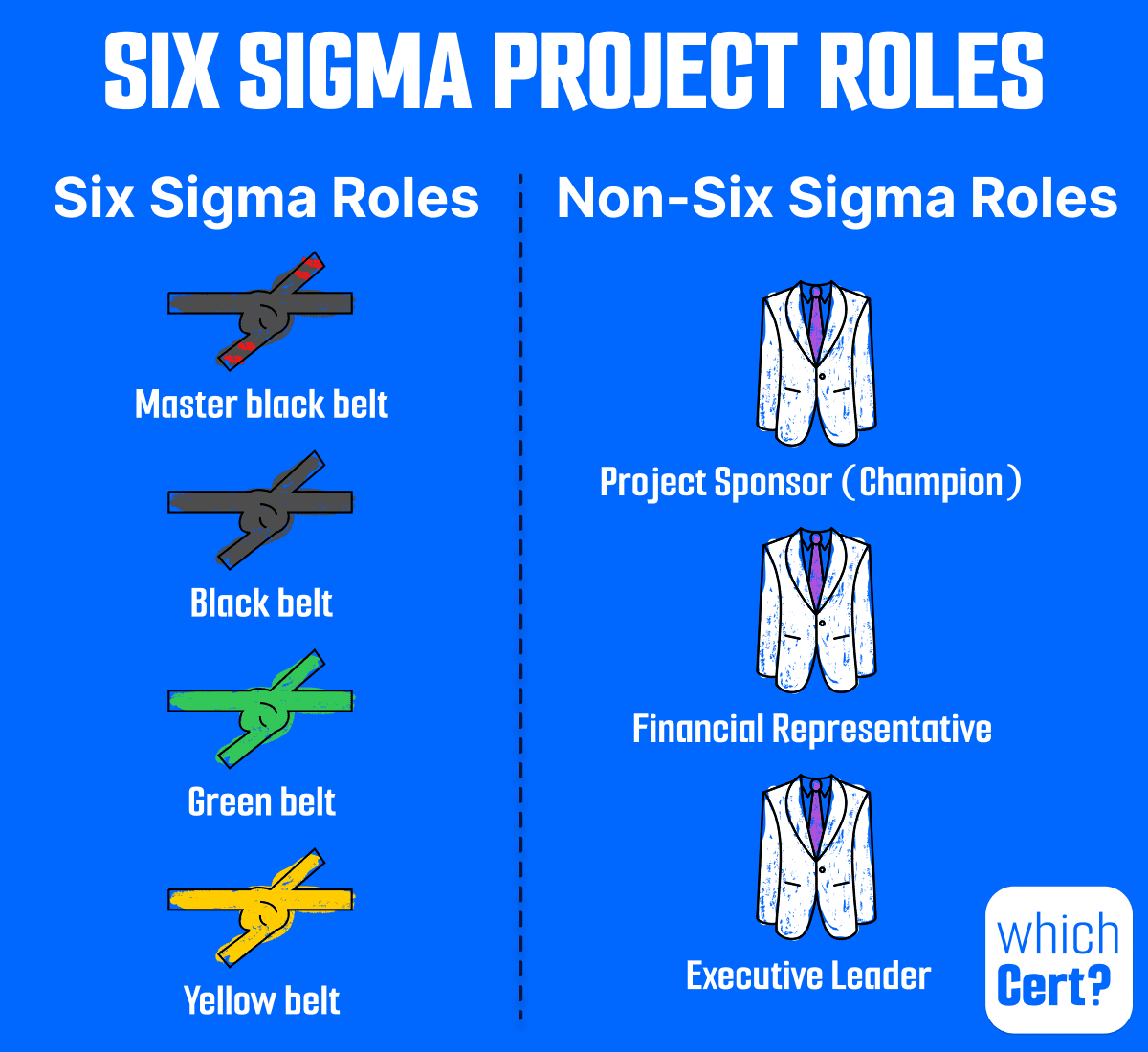
The graphic above sums up the split in the table: Yellow Belt, Green Belt, Black Belt, and Master Black Belt are the actual Six Sigma roles, defined by training level. The project sponsor role (also called a Champion), Financial Representative, and Executive Leader are non-Six Sigma roles — people who support a DMAIC project without necessarily holding a Six Sigma belt themselves.
Don’t confuse a Six Sigma training level with your job role
A Six Sigma belt is a training level, not a job title. Yellow Belt, Green Belt, Black Belt, and Master Black Belt describe how much Six Sigma methodology and which tools someone has learned — nothing more. Your actual job title (Quality Engineer, Process Improvement Manager, Operations Analyst, or something else entirely) is separate from that.
The reverse is also true: some of the roles on a DMAIC project team, like the project sponsor, Financial Representative, and Executive Leader, don’t require a Six Sigma belt at all. They support the project from a business or leadership angle rather than running the statistical analysis themselves.
So when you see Six Sigma training levels listed alongside job roles, remember: the belt tells you someone’s skill level, and the role tells you what they actually do on the project. A Black Belt could hold almost any job title — the belt is the qualification, not the position.
This distinction matters even more once you start weighing Six Sigma against project management certifications like PMP, Agile, and Scrum.
Is an in-house certification from a corporation a certification type? (Six Sigma belt vs. Six Sigma role)
Yes, but we don’t list it on WhichCert.com as a separate certification type, because it’s generally not publicly accessible.
We also prefer to define it as a Six Sigma role rather than just a certification level, because the role itself carries real professional responsibilities.
There’s an important distinction between earning a certification and actually performing the role in the industry. For example, it’s difficult to consider someone who obtained a “Black Belt” in just a few hours as fully prepared to lead DMAIC projects, apply advanced statistical methods, or mentor Green Belts in a professional environment.
In practice, experience matters a lot. Personally, I would trust a Yellow Belt who has participated in two real DMAIC projects more than someone holding a superficial Black Belt certification without practical understanding.
What is the salary of a Six Sigma professional?
- Six Sigma Yellow Belt: Average salary is $65,000
- Six Sigma Green Belt: Average salary is $85,000
- Six Sigma Black Belt: Salary range is $95,000 – $110,000
- Six Sigma Master Black Belt: Salary range is $100,000 – $135,000
Source: https://www.sixsigmacouncil.org/six-sigma-certifications
If you are still wondering whether Six Sigma certification is truly worth it, explore our complete breakdown of its career benefits, practical value, salaries, and relevance in 2026.
What are the accreditation bodies for Six Sigma certification?
Six Sigma accreditation isn’t governed by a single global authority. In fact, programs offered by reputable institutions and universities — though not formally accredited — are often equally respected, and in some cases, even more valued for their practical relevance and industry alignment.
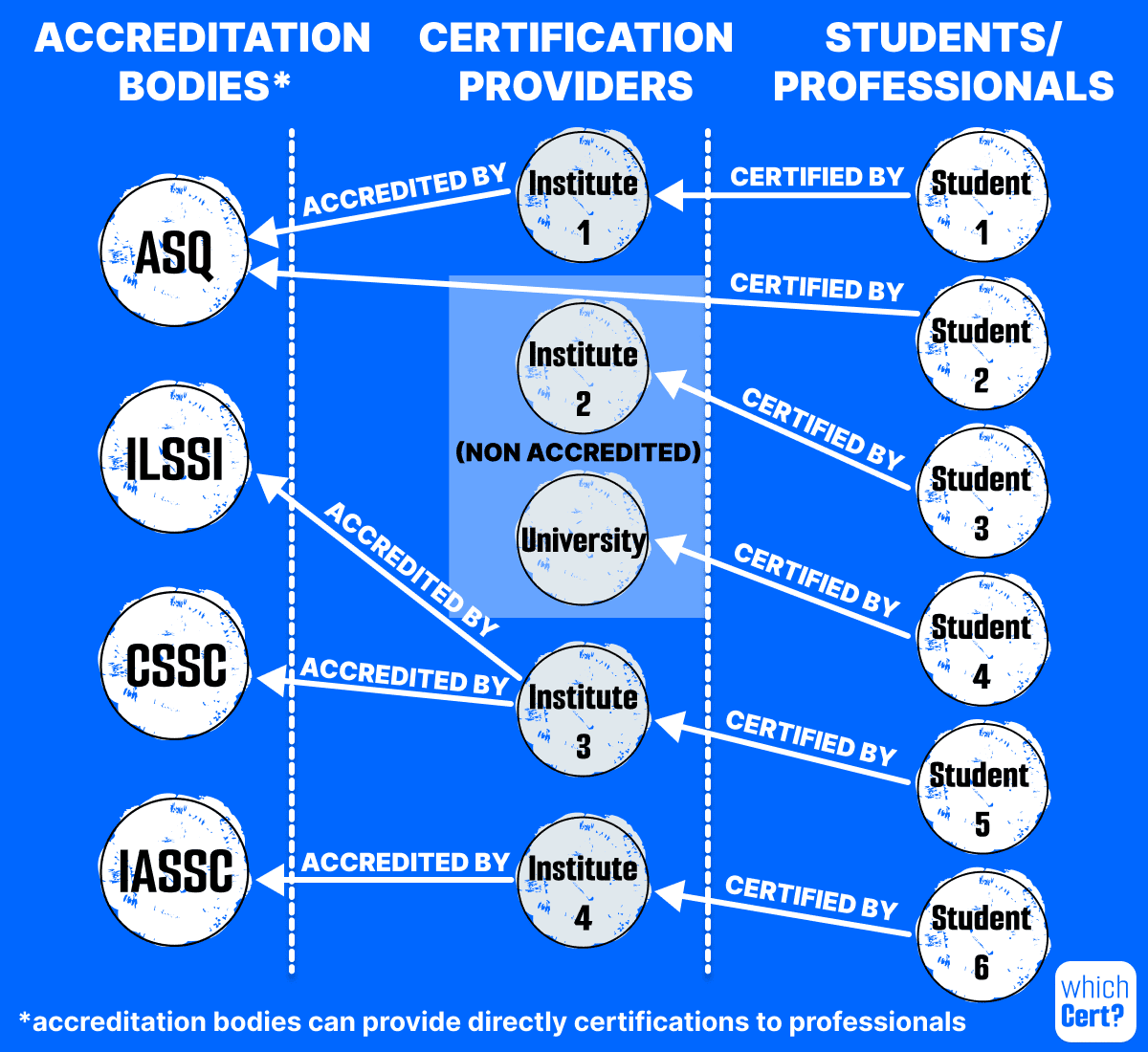
The graphic above shows how this works in practice: accreditation bodies (ASQ, ILSSI, CSSC, IASSC) accredit certification providers — training institutes and universities — which then certify individual professionals. Not every respected provider goes through this chain, though: some universities and institutes issue certificates without being accredited by any of the four bodies, which is the “not formally accredited, but equally respected” case mentioned above. Accreditation bodies can also skip the middleman entirely and certify professionals directly.
Want to understand what accreditation really means? Check out our beginner-friendly 5-minute guide here: What Is Accreditation?
The best-known accreditation bodies for Six Sigma certification are:
- ASQ (American Society for Quality)
- ILSSI (International Lean Six Sigma Institute)
- IASSC (International Association for Six Sigma Certification)
- CSSC (Council for Six Sigma Certification)
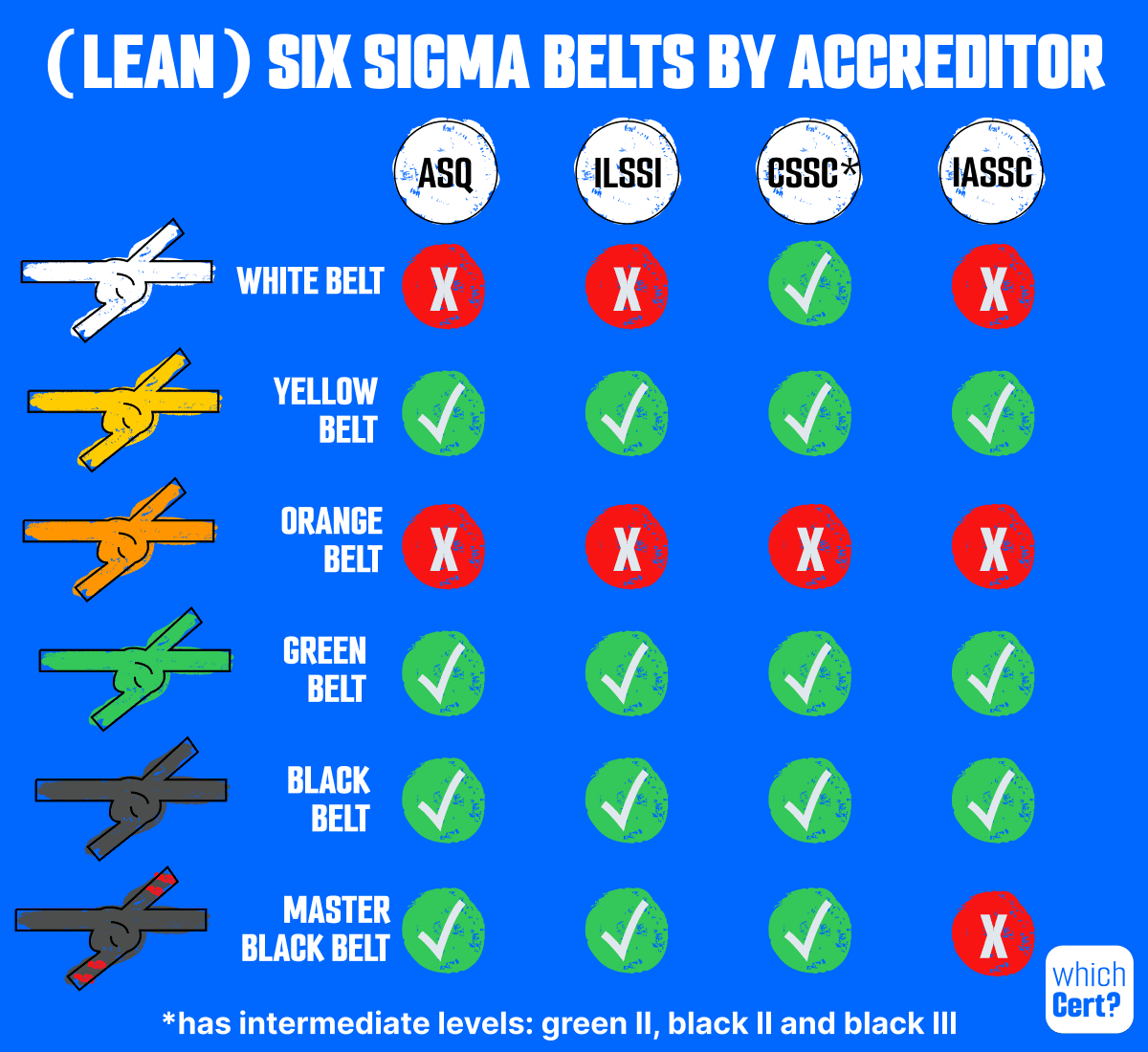
Here’s how the four bodies compare, belt by belt: Yellow Belt, Green Belt, and Black Belt are recognized across ASQ, ILSSI, CSSC, and IASSC. White Belt is only recognized by CSSC. None of the four currently recognizes an Orange Belt. Master Black Belt is recognized by ASQ, ILSSI, and CSSC, but IASSC treats Black Belt as its highest level. CSSC is also the only body offering intermediate levels — Green Belt II, Black Belt II, and Black Belt III.
Not all Six Sigma certifications carry the same weight. Learn how to identify the most recognized Six Sigma credentials.
Is a Six Sigma White Belt good?
Lean Six Sigma White Belt (or LSS White Belt) is not accredited by all accreditation bodies (ASQ, ILSSI, and IASSC) except the CSSC. Some certification providers offer awareness-level courses known as White Belt training. These are more like completion certificates than accredited Lean Six Sigma certifications. Hence, this certification lacks widespread recognition.
What is the highest Six Sigma belt?
The Master Black Belt is generally considered the top Six Sigma belt. The one exception is the International Association for Six Sigma Certification (IASSC), which recognizes Black Belt as its highest level.
Is there an orange belt within the Lean Six Sigma certification levels?
Few organizations offer an Orange Six Sigma Belt between Yellow and Green, but it lacks widespread acceptance.
What is Lean Six Sigma Green Belt Level 2?
Six Sigma belts vary by accrediting body (ASQ, ILSSI, IASSC, CSSC). While they are generally similar, CSSC stands out by offering intermediate levels — Green Belt II and Black Belt II & III.
Don’t confuse a Six Sigma certification level with a sigma (variability) level
Two different things share the word “level” here, and it’s easy to mix them up.
A Six Sigma belt — Yellow, Green, Black, Master Black Belt — is a certification level. It measures how much Six Sigma training a person has completed and what they’re qualified to do on a project.
A sigma level (as in “the process runs at 4 Sigma” or “6 Sigma quality”) is a statistical measure of variability. It describes how consistently a process performs against its specification limits — a 6 Sigma process produces about 3.4 defects per million opportunities, while a 3 Sigma process produces far more defects. This is what actually gives Six Sigma its name.
Want to explore the tools used to build quality into new designs? Check out this guide to Design for Six Sigma tools and methodologies.
What are the 5 stages of Six Sigma? (DMAIC)
Six Sigma projects focus on improving processes. They start with a clear problem and seek a solution through the following five steps (DMAIC):
- Define: Identify key customer requirements
- Measure: Map processes, collect data, and measure current performance
- Analyze: Establish hypotheses for improvement
- Improve: Validate the hypotheses and implement process improvements
- Control: Standardize the process and monitor it to maintain improvements over time
See DMAIC in action with a simple manufacturing example.
Lean Six Sigma certification vs. Six Sigma certification
By now you’ve seen DMAIC, the five-step framework at the core of Six Sigma. That’s the statistical, defect-reduction side of things.
Lean Six Sigma certification adds a second layer on top of that: Lean principles, which focus on eliminating waste and streamlining the process itself, rather than only reducing defects. A pure Six Sigma certification typically sticks to DMAIC and statistical process control. A Lean Six Sigma certification — like the belts covered in this guide — combines both, which is why most providers today teach the combined version rather than Six Sigma alone.
The naming isn’t always a reliable signal, though. ASQ, for example, calls its credentials “Six Sigma” certifications (Certified Six Sigma Green Belt, Certified Six Sigma Black Belt), but its Body of Knowledge still includes Lean tools and principles — so a “Six Sigma” name doesn’t necessarily mean Lean is left out.
There are also standalone Lean certifications that skip the Six Sigma/statistical side entirely and focus purely on Lean methodology.
ILSSI is a clear example of this in practice: they offer three distinctly named belt certifications for the same level — Lean Green Belt, Six Sigma Green Belt, and Lean Six Sigma Green Belt — each covering a different curriculum, exactly matching the distinction above.
We’ve broken down the differences in more detail here: Lean vs Six Sigma: Which Is Better?
Final Thoughts
Six Sigma typically includes four recognized belt levels in DMAIC improvement projects:
- Yellow Belt
- Green Belt
- Black Belt
- Master Black Belt
Lean Six Sigma certification levels can significantly impact your income and career growth!
Avoid hidden fees — see the full Six Sigma certification cost guide.
Ready to start your Lean Six Sigma journey? Enroll in one of the best White Belt (free) certification programs, or explore our carefully selected Yellow Belt, Green Belt, and Black Belt certifications to continue advancing your career.
FAQ
What does CSSGB mean?
Certified Six Sigma Green Belt; however, CLSSGB stands for Certified Lean Six Sigma Green Belt.
What is SSGB certification?
Six Sigma Green Belt certification; however, LSSGB stands for Lean Six Sigma Green Belt.