
If you’re weighing whether to enroll in the Lean Six Sigma program from the Technical University of Munich (TUM) on edX, here’s the short version: I went in with zero Lean Six Sigma background, completed the Yellow Belt, and I’d recommend it — provided you actually want to learn the material, not just collect a certificate as fast as possible.
Quick structure note before we dive in: the Yellow Belt is a prerequisite for the Green Belt. I’ve completed the Yellow Belt (reviewed in full below) but haven’t started the Green Belt yet, so anything I say about it is based on the program structure, not personal experience. There’s also an ASQ (American Society for Quality) angle worth knowing upfront — more on that in its own section below.
→ Enroll in the TUM Lean Six Sigma program on edX
Quick Verdict
| Criteria | Yellow Belt | Green Belt |
|---|---|---|
| Verdict | Highly recommended — completed and reviewed below. | A sustainability program (built around the SDGs, or Sustainable Development Goals) rather than a business one; requires a predefined project. |
| Best For | Beginners, students, engineers, quality professionals. | Students and unemployed learners especially — the project is predefined, so no workplace is needed. |
| ASQ Path | Curriculum covers the ASQ Six Sigma Green Belt Body of Knowledge. | N/A — project is TUM-specific. |
| Duration | 88 hours | 88 + 80 hours |
| Format | Fully online, self-paced | Fully online, self-paced |
| Regular Price | $546.30 | $1,301.40 (Yellow Belt included) |
How the TUM → ASQ Certification Path Works
One thing that isn’t obvious until you map it out: the TUM Yellow Belt isn’t just a standalone credential.
Its curriculum covers the ASQ Six Sigma Green Belt Body of Knowledge — the set of topics ASQ expects a Green Belt holder to know. That’s not because TUM and ASQ have some official partnership. It just means finishing the TUM Yellow Belt leaves you well-prepared for ASQ’s exam content. Anyone can register for an ASQ exam as long as they meet ASQ’s own eligibility rules (like a minimum years of experience for Green Belt) — TUM isn’t a gatekeeper here, just good preparation.
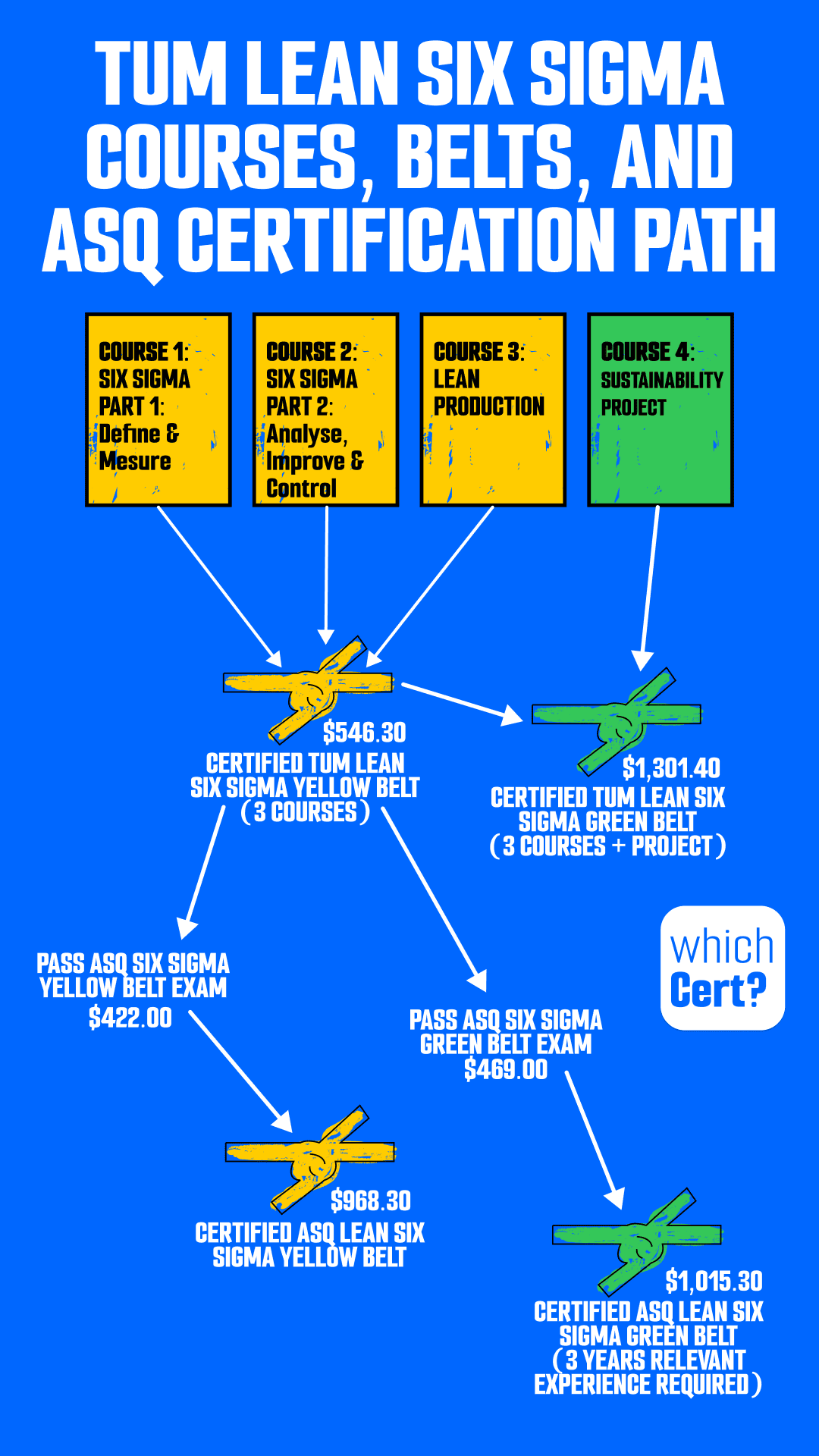
Here’s the breakdown from the diagram above:
- TUM Yellow Belt ($546.30) = Courses 1–3 (Six Sigma Define & Measure, Six Sigma Analyse/Improve/Control, Lean Production)
- TUM Green Belt ($1,301.40) = Courses 1–4, adding a sustainability project
- From the TUM Yellow Belt, you’re prepared to:
- Sit the ASQ Yellow Belt exam ($422) → Certified ASQ Lean Six Sigma Yellow Belt ($968.30 total)
- Sit the ASQ Green Belt exam ($469) → Certified ASQ Lean Six Sigma Green Belt ($1,015.30 total) — requires 3 years of relevant experience per ASQ’s rules
So depending on your experience level and goals, the TUM Yellow Belt alone can prepare you well enough for the ASQ Green Belt exam content — without needing to pay for TUM’s own Green Belt track.
My TUM Lean Six Sigma Yellow Belt Certificate
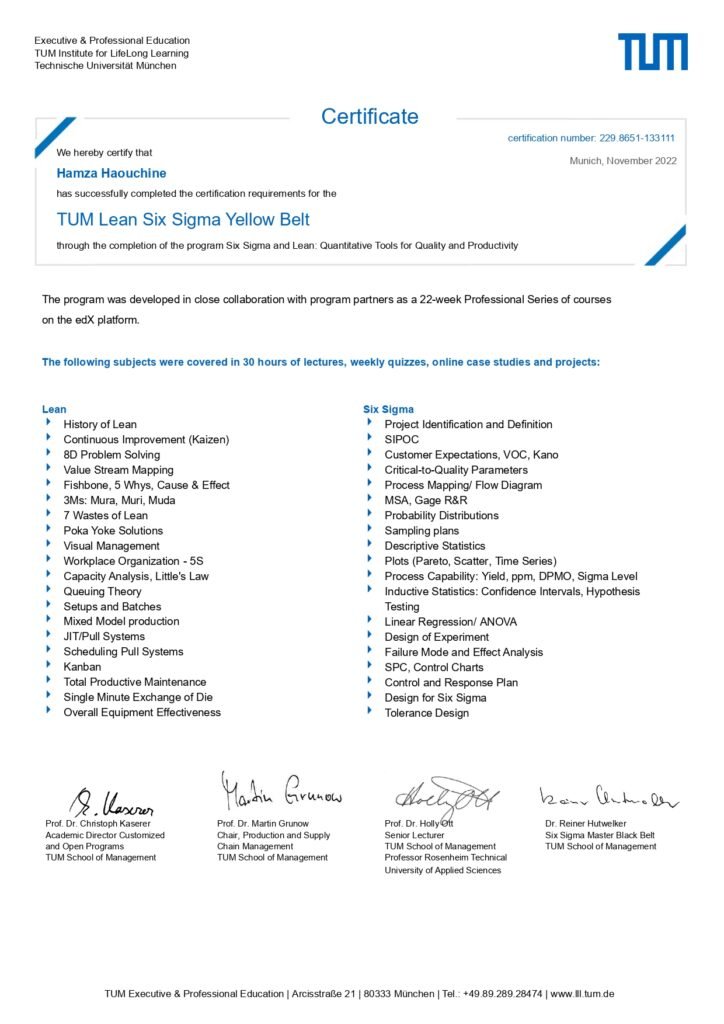
This is the official certificate issued by the TUM Institute for Lifelong Learning after completing the Yellow Belt requirements.
Why I Chose TUM Over Other Providers
At the time, I was working in quality compliance, auditing management systems against ISO 9001 (the international quality management standard). I understood the compliance side, but I wanted to go further — understanding how organizations actually use data to improve processes, not just verify conformity.
I first looked at local classroom training. Most options were five-day courses for $400+, which felt like exactly the “certificate of completion” trap I was trying to avoid — short, exam-focused, and light on real teaching.
The TUM program, by contrast, is built as an actual university-level course: about 88 hours of structured coursework, assignments, quizzes, and case studies for the Yellow Belt alone. That’s what convinced me to go with it over the shorter commercial alternatives.
What You Actually Get
- An edX certificate for each completed course
- An official Professional Certificate from the TUM Institute for Lifelong Learning (Yellow Belt), with a further certificate upon Green Belt completion
What you don’t get: university degree credits, a bachelor’s/master’s degree, ASQ certification, or professional engineering licensure. Worth knowing up front, since it’s easy to conflate a professional certificate with an accredited qualification.
Is It Worth the Price?
At $546.30 for the Yellow Belt (or $1,301.40 bundled with the Green Belt), it’s more expensive than a lot of quick online Yellow Belt courses — but those cheaper options are often exactly the shallow, exam-focused programs I was trying to avoid.
edX offers financial assistance, worth knowing about. I applied after finishing my first course, explained my situation, and got approved — which let me complete the rest of the program at a significantly reduced cost. If price is the only thing holding you back, check whether you qualify before writing the program off.
Even at full price, I think it’s good value if your goal is genuinely learning the material. If your only goal is the fastest possible certificate, this isn’t the cheapest way to get one.
My Experience With the Yellow Belt
Curriculum. It goes well beyond exam prep — Lean principles, Six Sigma fundamentals, process variation, basic statistics, DMAIC (Define, Measure, Analyze, Improve, Control), process capability, root cause analysis, quality tools, and practical improvement techniques. What stood out most: Lean gets its own full module instead of being tacked on as an afterthought to Six Sigma, which is how a lot of cheaper programs treat it.
Teaching quality. The statistics content is where I expected to struggle most, coming from a compliance background rather than a stats one. The instructors explain it in a structured, accessible way, and consistently tie formulas back to why they matter in real improvement projects — not just how to compute them.
Real-world examples. The case studies come from small and medium-sized German manufacturing companies, which made the Lean concepts click in a way abstract examples don’t.
Platform. Delivered through edX — clean interface, video transcripts, multilingual subtitles, progress tracking, and discussion forums with direct instructor interaction. No complaints here.
Workload. Honestly, this was a smooth experience overall — no major frustrations. The one thing to plan for is time: 88 hours is not a weekend project, and it’s noticeably heavier than most commercial Yellow Belt courses. If you want the fastest possible certificate, that pace will feel slow; if you want to actually retain the material, it’s appropriate.
Where it fell a bit short: a few guest lectures felt somewhat disconnected from the main curriculum flow — a minor point, but worth mentioning.
What’s Next: The Green Belt
I haven’t started the Green Belt yet, so I can’t review the experience firsthand. What I do know from the program structure:
- Builds on the Yellow Belt, adding roughly 80 hours
- Completion requires an improvement project — not just coursework and quizzes
- Designed to align with the ASQ Green Belt Body of Knowledge
The standout detail: TUM’s Green Belt project is a sustainability project centered on the SDGs, rather than a generic business-process project. Most Green Belt providers expect you to apply the improvement project inside a workplace — a real barrier if you’re a student or currently unemployed. TUM’s predefined project removes that barrier entirely: you don’t need a job to complete the certification.
I’ll update this section with a full review once I’ve completed it.
Who Should (and Shouldn’t) Get This
Get it if you:
- Are considering this as prep for ASQ Yellow or Green Belt certification
- Are new to Lean Six Sigma and want to actually understand it, not memorize for an exam
- Value a university-backed certificate over a generic online one
- Can commit to consistent study time over several weeks
Skip it if you:
- Want the fastest, cheapest possible certificate
- Need a certification specifically mandated by your employer (check their requirements first)
- Prefer live, instructor-led classroom training
- Can’t commit real study time right now
Final Verdict
The TUM Yellow Belt did more than get me a certificate — it changed how I think about process improvement and evidence-based decision-making. For the price and time investment, if your goal is real understanding rather than a quick credential, I think it’s one of the strongest beginner options on edX right now.
I’ll be starting the Green Belt next and will fold that experience into this post once it’s done.
→ Check current pricing and enroll on edX: Yellow Belt | Green Belt