
Designing a new product or a service requires a lot of resources, so much testing and redesigning.
Design for Six Sigma (DFSS) takes a more structured approach by building customer requirements, quality, and performance into the design from the beginning.
You’ll be using advanced tools to achieve or approach Six Sigma capability.
When an existing product or process does not meet performance requirements, DMAIC may be used to improve it. When the required performance cannot reasonably be achieved through conventional improvement, DFSS can provide a structured approach to redesign.
As you can see, DFSS goes further than traditional design. It is, as Paul Allen calls it, “World-Class Engineering”.

DFSS Tools Used in Each Product Development Phase
DFSS approaches can vary, but product and service development commonly involves understanding customer requirements, developing the design, and designing the process needed to deliver it.
Note
In quality engineering, when you read the term “product”, it often refers to either a product or a service, depending on the business offering.
1. Planning Phase: Voice of the Customer (VoC) — The Crucial Part!
The Voice of the Customer (VoC) captures customer needs, expectations, and requirements.
In DFSS, VoC is an important starting point because the design should ultimately deliver the characteristics that customers value.
Imagine designing a new smartwatch while assuming that you should make it lighter. You organize workshops, meetings, and you conduct hours of analysis to make it lighter.
Then you launch it to the market, and the number of sales won’t follow your expectations.
The issue then isn’t in the analysis and your optimization methods but in your target.
Assuming customers want lighter smartwatches was a wrong decision.
An important early step in product or service design is clearly understanding what customers and relevant stakeholders require.
Nailing this step ensures you are moving in the right direction. Losing it means losing all your efforts.
Failing at this step won’t bring the important value expected by the customer because it would make the rest of the process optimize and improve the wrong features.
Below is a famous illustration reproduced from the University of London Computer Centre Newsletter No. 53, March 1973.
It showcases (with exaggeration) the reality of failing to plan the design.

Understanding customer needs is conducted by different methods and tools:
1.1. Customer Interview
Many people skip it and jump directly to surveys, while surveys at this stage are misleading.
Surveys assume features of your prototype (idea) and give less opportunity to hear from customers openly what they really want.
Interviews should be conducted with different stakeholders relevant to your offering (product/ service). If we stay in the smartwatch example, the stakeholders may be: current customers, potential customers, retailers, and product reviewers.
You shouldn’t ask questions like “Would you prefer us to make the watch lighter?” The answer would be “Yes” or “No”. The most useful insights often come from open-ended questions.
Interviews can be used for two different purposes:
- Understanding the problem: right before creating a clear idea or prototype of your future product/ service.
- Assessing the solution: at the idea testing stage (prototype).
1.2. Surveys
Are useful to quantify and analyse specific details where you still have doubts. The objective is to mitigate the assumptions as much as possible.
You can even check the pricing using Monadic pricing method.
Surveys can help quantify customer preferences across a larger sample. However, the quality of the results depends on factors such as sample selection, question design, response rate, and potential sources of bias.
One of the best practices is to use Likert scale that simplifies the questions by easy declarative sentences.
For example, a Likert-scale question could use the statement “WhichCert.com is easy to navigate,” followed by five response options:
1 — Strongly disagree
2 — Disagree
3 — Neither agree nor disagree
4 — Agree
5 — Strongly agree
Letting an option to stay neutral without forcing a response makes the data reliable.
1.3. Prioritization Tools
Imagine you have got 20 ideas to implement at this stage. Does each one weigh equally?
Certainly not!
To solve it, you can use two tools that give different outcomes, but both help with prioritization:
1.3.1. Kano Model
This Japanese tool helps assess the features that you want to implement. I recommend adding even features that you decided to not implement.
The assessment helps you categorize five types of features:
- Must-Have (Basic): It must be included because customers expect it to be (It can therefore be useful to assess even features that were initially considered for exclusion, particularly when their absence could cause significant customer dissatisfaction.).
- Performance (One-Dimensional): When we add more, the satisfaction will increase in a linear way. The more, the better.
- Delighters (Excitement): Wow features are not expected by the customers, but they create high excitement if they exist.
- Indifferent: Attributes that do not impact user satisfaction.
- Reverse: Features that cause dissatisfaction.

The assessment is conducted by asking customers both functional and dysfunctional questions about each feature.:
- Functional questions: whether the product/service would include a feature
- Dysfunctional questions: if the product/ service won’t have a feature
After the answers are gathered, the results for each feature would be assessed using the matrix below:
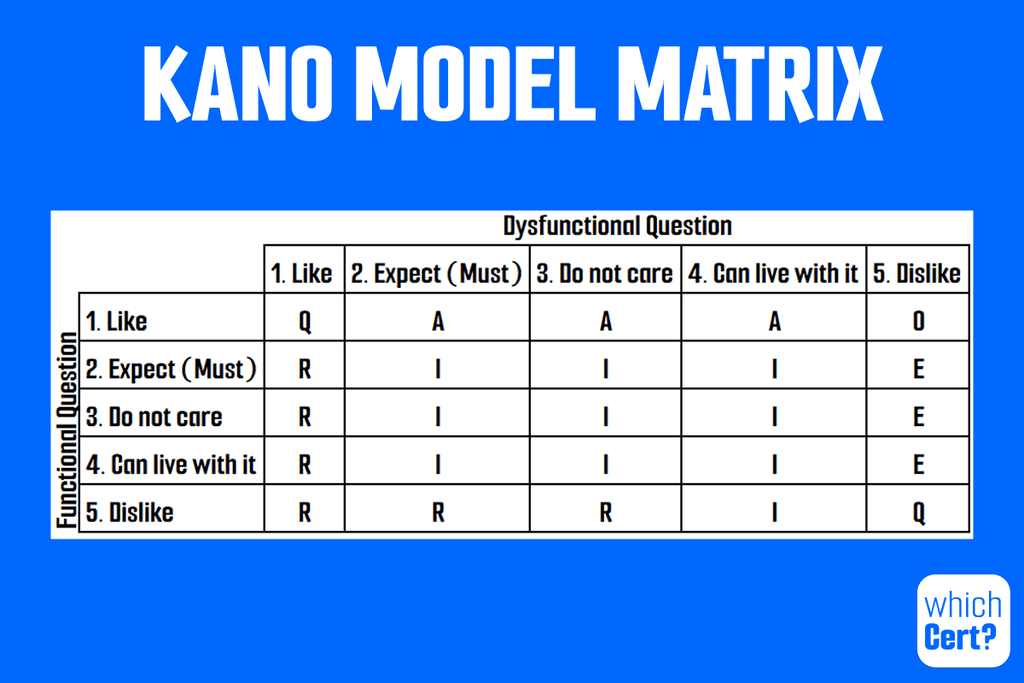
The conclusions are whether a feature is:
A: Attractive/ Excitement
E: Expected/ Basic
O: One-Dimensional/ Performance
I: Indifferent
R: Reverse
Q: Questionable Response
1.3.2. Quality Function Deployment
It is used to tie design features of a product with the expressed preferences and needs of the customers.
It helps also prioritizing those features and choose the most important ones.
QFD helps prioritize technical characteristics by considering their relationships with customer requirements and the relative importance of those requirements.
The tool used is a matrix called the House Of Quality (HOQ).
Typically:
- The left side contains the customer requirements or Voice of the Customer.
- The upper section contains the technical requirements.
- The center contains the relationship matrix between customer and technical requirements.
- The “roof” represents relationships among the technical requirements.
- Competitive comparisons can be used to evaluate the organization’s offering against competing products or services.
- Target values can then be established based on customer expectations, competitive benchmarks, and design objectives.
QFD and the House of Quality are therefore important concepts for professionals studying DFSS certification because they demonstrate how customer expectations can be translated into design decisions.
2. Product (or Service) Design
2.1. Design of Experiments (DOE)
This common Six Sigma tool is applied both to new product design and to existing ones and their processes using the DMAIC framework.
At the product design stage, we use DOE to systematically vary design parameters and identify those that most influence the characteristics critical to customers (CTQs), so we can optimize the design.
Paul Allen provides a useful example of using Design of Experiments to determine appropriate design parameters for an electrical motor.
In this example, Paul is varying different parameters (number of coils, wire thickness, number of turns, silver percentage, core density of the iron) to achieve the desired targets.
2.2. Design FMEA
Design Failure Mode and Effects Analysis helps identify potential failure modes in a product design and assess their possible effects. It supports design teams in addressing risks before the product reaches production.
3. Process Design
3.1. Process FMEA
Similar to Design FMEA, this assessment has to be performed for any new process or current process that will be used to produce the new product/ service.
The outcome is also corrective actions to mitigate the failure of the process.
Common DFSS Methodologies
DFSS does not follow a single universal methodology. DMADV and IDOV are commonly discussed approaches, while some organizations and certification providers use different frameworks or terminology.
1. DMADV
DMADV stands for:
Define, Measure, Analyze, Design, Verify
It is one of the methodologies associated with DFSS and can be used to design new products or processes and to redesign existing ones that cannot achieve the required performance through conventional improvement methods.
Because DMADV provides a structured design approach, it is also commonly included in DFSS certification programs.
1.1. Define
Define sets the priorities. Not every design objective carries equal weight, so this phase is about identifying which ones will actually move the needle toward Six Sigma performance targets — and which are secondary.
1.2. Measure
Requirements only become useful once they’re measurable. Measure takes what customers and stakeholders said they wanted and converts it into design criteria you can actually evaluate against — numbers, tolerances, thresholds, not impressions.
1.3. Analyze
Analyze brings in the statistics. Design teams use statistical and analytical techniques here to work out which factors deserve the most attention — and, just as usefully, which ones don’t.
1.4. Design
This is where the requirements turn into an actual design. Detailed specifications get built, prototypes or pilot designs get tested, and the design is refined until it meets the performance bar set earlier.
1.5. Verify
Verify is the check. Testing and validation confirm the design actually performs as intended, not just on paper.
2. IDOV
Another methodology used in DFSS is IDOV, which stands for:
Identify, Design, Optimize, Verify
IDOV focuses on developing robust products and processes that meet customer requirements and desired performance characteristics.
Like DMADV, IDOV may be covered in DFSS certification and training programs, although the exact methodology and tools included depend on the certification provider.
2.1. Identify
Identify starts where DFSS always starts: the Voice of the Customer and the business case behind the project. From there, customer requirements get translated into technical ones — CTQs and specification limits included.
2.2. Design
Design concepts get tested against potential failure modes here, and DOE earns its keep — it’s how you find out which combination of parameters actually delivers the CTQs you set out to hit.
2.3. Optimize
Optimize is where the design gets pushed toward its performance target: process capability, statistical tolerance, error-proofing, robustness, reliability.
2.4. Verify
Same principle as DMADV’s Verify: prototypes, iterations, and testing confirm the design holds up against what was required, and it gets refined until it’s ready to ship.
What Is DFX in Design for Six Sigma?
One of the key objectives of DFSS is to ensure that important product and process attributes are considered from the beginning of the design process and remain part of subsequent development and testing activities.
This concept is often referred to as DFX, or Design for X, where “X” represents a specific attribute that needs to be considered during design. Where the specific “X” categories used can vary by industry and organization.
Common examples of Design for X include:
1. Design for Cost
Cost is rarely negotiable, so Design for Cost is about finding alternative materials, processes, or methods that hit the target price without gutting the performance that matters.
2. Design for Assembly
Design for Assembly is easier to get right when production staff are in the room early — their input on what’s hard to assemble often reshapes the design before manufacturing ever sees it.
3. Design for Testability
Waiting until final functional testing to find problems is expensive. Design for Testability builds the ability to test in from the start.
4. Design for Maintainability
For anything with a long operating life and real maintenance demands, Design for Maintainability decides how much that upkeep will cost — in time and money — for years after launch.
5. Design for Robustness
A product that only works under ideal conditions isn’t much of a product. Design for Robustness targets consistent performance across varying conditions, often measured through MTTF and MTBF.
6. Design for Agility
Design for Agility is about how fast the design can bend — customization, quick adaptation, keeping up when customer requirements shift.
7. Design for Usability
None of the above matters much if customers find the product frustrating to use — Design for Usability keeps that experience part of the conversation from the start.
DFSS Certification: What Does It Cover?
A DFSS certification is generally aimed at professionals who want to develop skills in designing or redesigning products, processes, and services using Six Sigma principles.
While standalone DFSS certifications are less common than mainstream Lean Six Sigma belt certifications, DFSS content may also be included within broader Lean Six Sigma programs. The International Lean Six Sigma Institute (ILSSI) and the Management and Strategy Institute (MSI) offer standalone Design for Six Sigma certifications.
The exact curriculum varies between providers, so it is important to check what a certification actually covers before choosing a program.
A DFSS certification may include:
- DFSS methodologies such as DMADV or IDOV
- Voice of the Customer and CTQs
- Kano Model
- Quality Function Deployment (QFD)
- House of Quality
- Design FMEA (DFMEA)
- Process FMEA (PFMEA)
- Design of Experiments (DOE)
- Robust design and optimization
- Design for X (DFX)
- Product and process verification
Some programs focus heavily on the theoretical methodology, while others include practical design exercises, case studies, or projects.
This is why the certification provider and its curriculum matter as much as the DFSS label itself. Someone comparing DFSS certifications should look beyond the certificate name and examine the methodology taught, training depth, practical requirements, assessment method, and any accreditation or recognition associated with the program.
Is DFSS Certification Worth It?
A DFSS certification can be particularly relevant for professionals involved in product development, process design, engineering, quality, manufacturing, and innovation.
However, its value depends heavily on the quality and relevance of the program rather than simply having “DFSS” written on the certificate.
Before choosing a DFSS certification, consider:
- Which DFSS methodology is taught?
- Does the program cover practical tools such as QFD, DFMEA, and DOE?
- Is there a project or practical application?
- How is the candidate assessed?
- Who provides or accredits the certification?
- Is the certification relevant to the industry and role you are targeting?
A short introductory course and a comprehensive certification program may both use the DFSS name while providing very different levels of training.
Final Thoughts
Design for Six Sigma takes a different approach from traditional process improvement.
While DMAIC focuses primarily on improving an existing process or product, DFSS focuses on building quality, performance, and customer requirements into the design itself.
Methodologies such as DMADV and IDOV, together with tools such as VoC, QFD, FMEA, and DOE, provide organizations with structured ways to develop products, processes, and services that meet customer and performance requirements from the beginning.
For professionals interested in this area, DFSS certification can be a way to develop specialized skills in design and innovation, but certifications should be compared carefully based on their methodology, curriculum, practical requirements, assessment, and recognition rather than the certificate title alone.
Explore Lean Six Sigma certifications
Discover our selected Yellow Belt, Green Belt, and Black Belt programs.