
Although Lean management principles have influenced project management, Lean Six Sigma is different from project management certifications.
While Six Sigma or Lean Six Sigma certifications focus on quality and process improvement, PMP, Agile, Scrum, and PRINCE2 cover different aspects of project management.
In this article, we are going to see:
What is Lean Six Sigma?
Lean Six Sigma is a methodology and a set of principles and tools used to reduce waste (the seven wastes) and variation in products and processes to achieve operational excellence.
Lean Six Sigma certifications
The most common Lean Six Sigma certifications are represented by belt colors in ascending order: Yellow Belt (level 1), Green Belt (level 2), Black Belt (level 3), and Master Black Belt (level 4).
The certification levels generally represent different roles and levels of responsibility within a Six Sigma or Lean Six Sigma project team.
Lean vs Six Sigma
Lean manufacturing or Lean management consists of a set of principles and tools mostly inspired by the Toyota Production System.
These tools aim to reduce waste by delivering more value to customers.
On the other hand, Six Sigma is a framework created by Motorola that uses statistical approaches to reduce process variation to:
- Maintain the process at a Six Sigma level: tolerate only 3.4 defects per million opportunities.
- Launch a Six Sigma project whenever a problem related to variation is detected (and prioritized), to investigate it using statistical methods, find the root cause, and continuously improve the process.
Lean and Six Sigma are often combined because their approaches complement each other. Lean focuses strongly on waste and flow, while Six Sigma focuses more heavily on variation, data, and statistical analysis.
Project Management Certifications
Project management certifications are aimed at a broad range of professionals. Although some project management approaches became particularly common in software development, many of their principles and frameworks can be applied in different fields.
There are two major approaches to project management:
- Predictive: the project follows predefined phases where deliverables and requirements are planned.
- Adaptive: when uncertainty and changing requirements are important, the adaptive approach allows the team to deliver work in cycles and adapt based on feedback.
There is also a hybrid approach where predictive and adaptive approaches are combined.
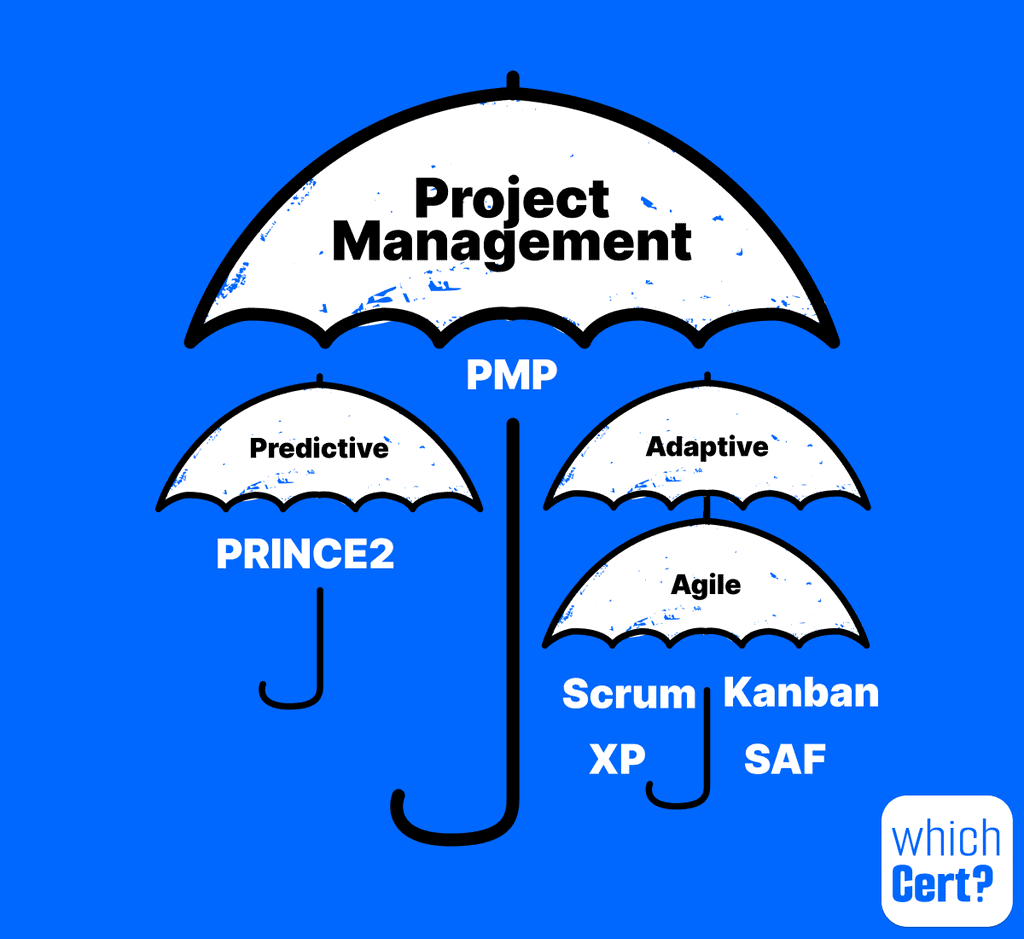
Below are some well-known project management certifications and approaches.
Project Management Professional (PMP®) certification
Approaches covered: predictive, adaptive, and hybrid.
Governed by the Project Management Institute (PMI®), PMP is one of the most recognized project management certifications in North America and globally.
It is a broad project management certification that demonstrates knowledge and competence in leading projects across different industries.
Agile certification
Approach covered: adaptive.
Agile is a set of values and principles that were formalized in the Agile Manifesto in 2001.
Agile is broader than any single project management methodology or framework. It provides a philosophy and principles for working in environments where requirements can change and where frequent feedback and incremental delivery are important.
Values
Individuals and interactions over processes and tools
Working software over comprehensive documentation
Customer collaboration over contract negotiation
Responding to change over following a planThat is, while there is value in the items on the right, the items on the left are valued more.
Principles
The Agile Manifesto also contains 12 principles. They emphasize areas such as delivering value frequently, collaborating with customers, supporting effective teams, welcoming change, and continuously improving.
The principles can also be grouped under four themes by Sue Lueder:
- Value Delivery: Delivering the work as quickly as possible in order to get feedback and mitigate time risk.
- Business Collaboration: Collaborating with customers helps the team get critical business information immediately, allowing it to adjust and adapt to new information.
- Team Dynamics and Culture: Creating an effective team culture that is inclusive, supportive, and empowering.
- Retrospectives and Continuous Learning: Striving to continuously learn and adapt to what is and is not working.
Agile is an umbrella covering different approaches, methodologies, and frameworks such as Scrum, eXtreme Programming, Kanban, SAFe (Scaled Agile Framework), and Lean. There are also Agile certifications such as PMI Agile Certified Practitioner.
Therefore, Agile should not be viewed as simply another methodology alongside Scrum or PRINCE2. It is a broader approach that has influenced and shaped multiple ways of managing and delivering work.
Scrum certifications
Approach covered: adaptive.
Scrum is an Agile framework that gives teams a practical structure for developing and delivering products through iterations called sprints. A sprint generally lasts two weeks.
Scrum provides clearly defined accountabilities, events, and artifacts that help teams organize their work and continuously inspect and adapt.
These accountabilities also have associated certification paths.
Scrum Master Certification
The certification levels, in ascending order, are: Certified ScrumMaster (CSM®), Advanced Certified ScrumMaster (A-CSM®), and Certified Scrum Professional-ScrumMaster (CSP®-SM).
Scrum Masters help the team understand and apply Scrum and support an environment where the team can work effectively.
They can also help remove impediments and facilitate collaboration within and outside the team.
Product Owner Certification
The certification levels, in ascending order, are: Certified Scrum Product Owner (CSPO®), Advanced Certified Scrum Product Owner (A-CSPO®), and Certified Scrum Professional-Product Owner (CSP®-PO).
Product Owners are responsible for maximizing the value of the product resulting from the Scrum Team’s work.
Developer Certification
The certification levels, in ascending order, are: Certified Scrum Developer (CSD®), Advanced Certified Scrum Developer (A-CSD®), and Certified Scrum Professional-Developer (CSP®-D).
Developers are responsible for creating usable increments of the product during each sprint.
PRINCE2® Certification
Approach covered: predictive.
Originally developed for the UK government, PRINCE2 stands for PRojects IN Controlled Environments.
PRINCE2 is a structured project management method that places strong emphasis on governance, defined roles, processes, and controlled project delivery.
It is widely used in government, the public sector, and large organizations, although it can also be applied in other types of organizations.
Lean Six Sigma vs Project Management Certifications
Although Lean Six Sigma and project management certifications overlap, they generally serve different purposes.
| Certification / Approach | Main Focus | Typical Use | Best Suited For |
|---|---|---|---|
| Lean Six Sigma | Process improvement, waste reduction, variation reduction, and quality | Improving existing processes and solving performance or quality problems | Quality, continuous improvement, operational excellence, and process improvement professionals |
| PMP | Project management knowledge and leadership | Planning and delivering projects across different industries | Project managers and professionals who lead or manage projects |
| Agile | Adaptability, customer collaboration, incremental delivery, and continuous feedback | Environments where requirements and priorities can change | Professionals working in adaptive and iterative environments |
| Scrum | Iterative product development and team collaboration | Managing complex product development through short iterations | Scrum Masters, Product Owners, Developers, and Scrum Team members |
| PRINCE2 | Project governance, structure, roles, and controlled delivery | Managing projects through a structured method | Professionals working in structured project environments |
The important distinction is that these certifications and approaches do not necessarily compete with one another. A professional may use project management skills to manage a Lean Six Sigma improvement project, for example.
How Lean Management Principles Influenced Project Management
Lean management principles encourage professionals to identify and eliminate waste while focusing on customer value and efficient flow. These ideas have also influenced modern approaches to project and product management, including Agile.
Lean and Agile share several principles, such as focusing on customer value, reducing unnecessary work, delivering incrementally, and continuously improving.
However, Lean and Agile should not simply be treated as the same methodology. Lean originated primarily from manufacturing and operational improvement, while Agile developed as a broader approach to managing work in environments characterized by uncertainty and changing requirements.
Lean management is built on five core principles:
- Define value from the customer’s perspective
- Identify and map the value stream
- Reduce waste and improve flow
- Move from “push” to “pull” based on customer demand
- Pursue perfection
Applied to project management, these principles translate into the following:
- Define Value: Identify and focus on what the customer wants and involve the customer.
- Map Value Stream: Map out the steps involved in delivering the product or service and challenge unnecessary steps.
- Create Flow: Ensure the product or deliverable flows through the value stream efficiently, eliminating waste throughout the cycle.
- Establish Pull: Allow customer demand and feedback to influence what the team delivers and when it delivers it.
- Pursue Perfection: Continuously improve the previous four steps.
Lean Six Sigma in Project Management
Lean Six Sigma can be used to improve business processes in organizations that are project-based.
For example, an organization could use Lean Six Sigma to improve software delivery by reducing variation in the development or delivery process. It could also identify and eliminate overprocessing as one of the forms of Lean waste.
Lean Six Sigma can therefore complement project management when a project is intended to improve an existing process.
Project Management in Lean Six Sigma
Lean Six Sigma has its own structured approach for improvement projects.
For existing processes, it is called DMAIC, while DMADV can be used when designing or redesigning processes or products.
Project management knowledge can be particularly useful for Lean Six Sigma professionals who lead complex improvement initiatives. A Black Belt or Master Black Belt who manages significant projects may therefore benefit from a project management certification such as PMP.
Similarly, professionals managing a group of related improvement projects may benefit from program management knowledge. In such cases, the Program Management Professional (PgMP) certification may be relevant, depending on the nature of the work.
Which Certification Should You Choose?
The right certification depends on the type of work you want to perform.
- Choose Lean Six Sigma if your primary goal is process improvement, quality, waste reduction, or operational excellence.
- Choose PMP if you want broad project management knowledge and want to lead projects across different industries.
- Choose Agile if you work in an environment where requirements change frequently, and teams need to deliver and adapt continuously.
- Choose Scrum if you specifically work with or want to work with Scrum teams and product development.
- Choose PRINCE2 if you prefer a structured project management method with strong governance and defined processes.
You can also combine these areas. For example, a professional may use Lean Six Sigma to improve a process while using project management skills to plan and manage the improvement project.
Organizations Behind Lean Six Sigma and Project Management Certifications
Different organizations develop, maintain, or provide certifications related to Lean Six Sigma and project management.
| Certification / Approach | Organizations |
|---|---|
| Lean Six Sigma |
American Society for Quality (ASQ) International Lean Six Sigma Institute (ILSSI) International Association for Six Sigma Certification (IASSC) Council for Six Sigma Certification (CSSC) |
| PMP | Project Management Institute (PMI) |
| Agile Certified Practitioner | Project Management Institute (PMI) |
| Scrum Certifications |
Scrum.org Scrum Alliance |
| PRINCE2 | AXELOS |
| SAFe® | Scaled Agile |
Final Thoughts
Lean Six Sigma focuses on process improvement and quality, while project management certifications focus on managing and delivering projects. However, the two areas can complement each other, allowing professionals to combine process improvement expertise with project management, Agile, Scrum, or PRINCE2 skills depending on their career goals.
Ready to choose your path?
If your priority is process improvement, quality, and waste reduction, compare our top-rated Yellow Belt, Green Belt, and Black Belt certification programs.