
Accreditation is the process of confirming that an organization is qualified to perform certification, calibration, or any other conformity assessment.
Before enrolling in any certification, you should know what is accreditation. This detailed guide will help you understand it and why it’s important for choosing the right accredited certification.
I will use a simple story with easy examples and illustrations to help beginners understand what is accreditation and what is the difference between accreditation and certification.

In this guide, you’ll learn:
Why is Accreditation important? (the story)
Imagine you live in an old village called Bamboo Village, where no units of measurement exist—no meters, inches, or pounds.
You sell ropes in the market, and the only thing you can tell your best customer is:
“I’m giving you more rope than last time — can you give me more rice?”
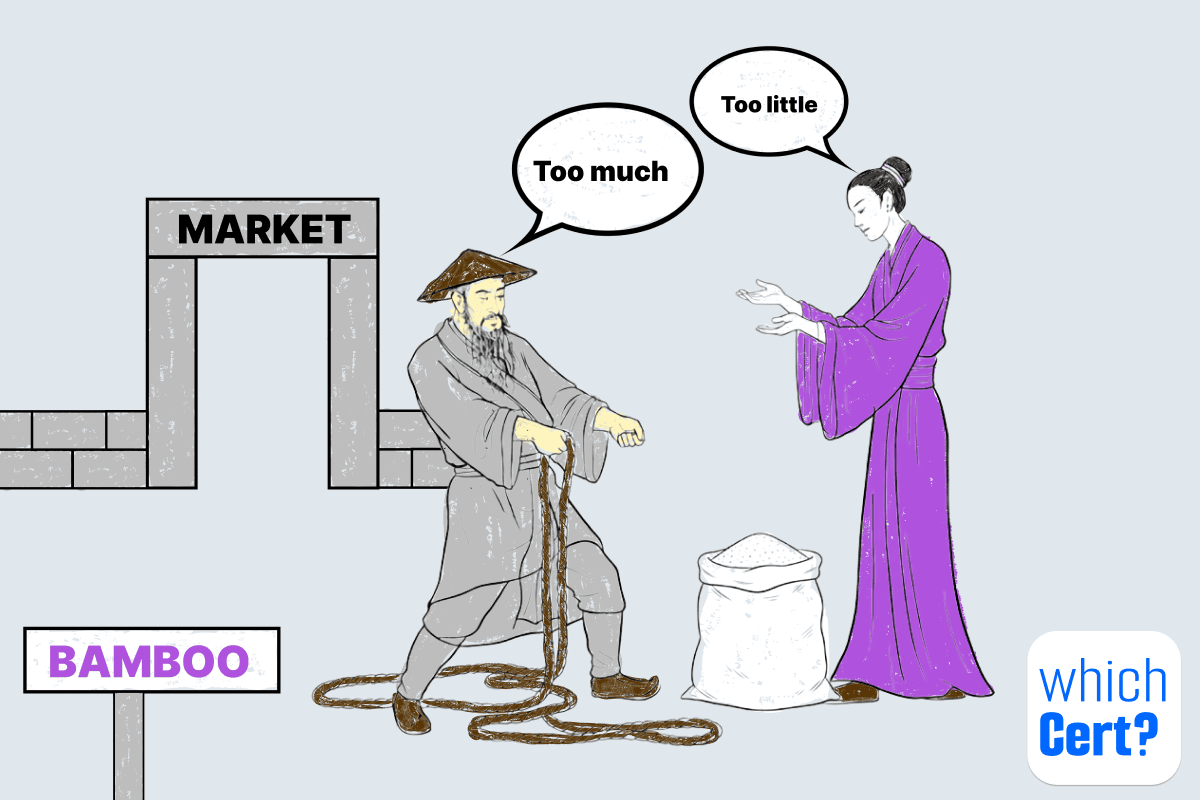
This system is confusing for everyone.
To solve this, merchants start using the cubit, the distance from the elbow to the tip of the middle finger.

But soon, clients prefer buying from the tallest merchant, because his cubit is larger.
In other words, the measurement is not fair or consistent.
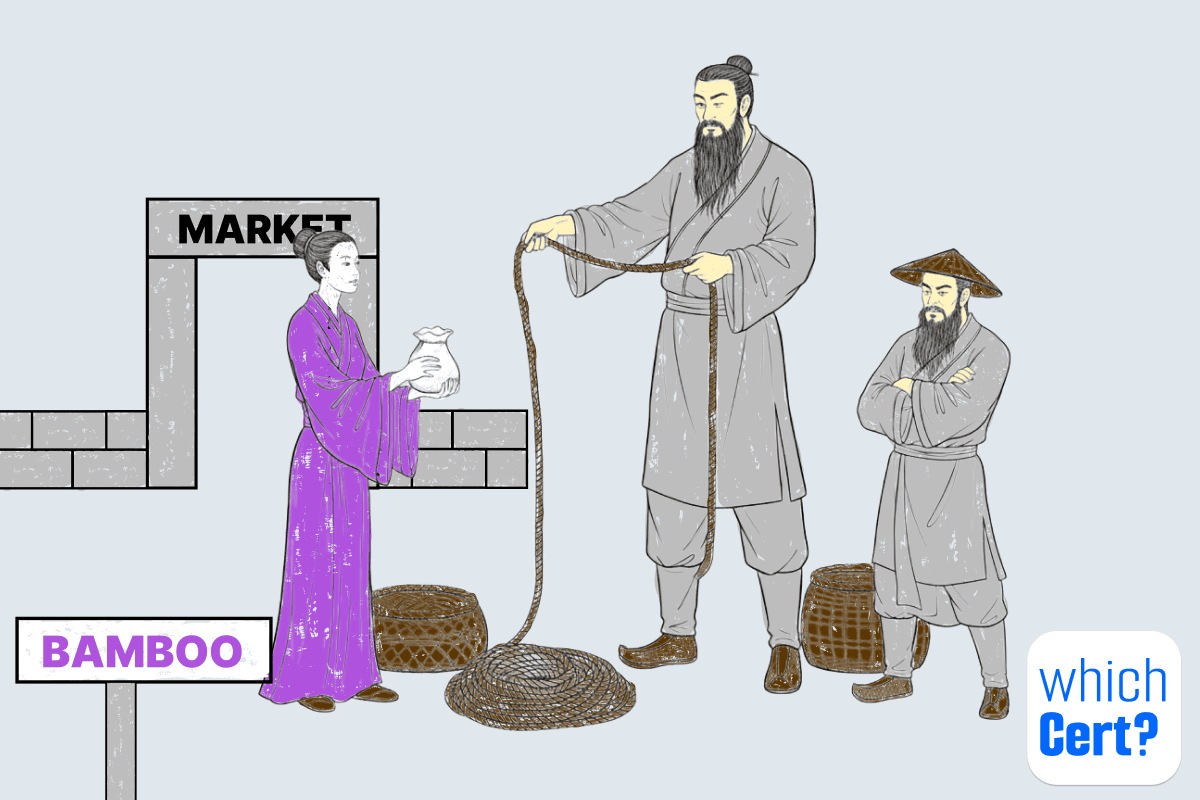
So the village chief decides to place a long rock at the entrance of the market as the official unit of length.
Merchants use wooden sticks to measure, and calibration inspectors at the entrance check if each stick matches the length of the rock.

Later, you travel to a nearby village called Wooden Village to sell your ropes.
You explain the benefits of using clear measurement units instead of “too much” or “too little.”
The Wooden village chief likes the idea. He has two choices:
- Create his own rock with a different length
- Use the same rock length as Bamboo Village’s to make trade easier.
To simplify transactions, he wisely decides to adopt the same rock length as Bamboo village.
As this system spreads, Bamboo’s chief sets up an office to check other villages and make sure their “rocks” still match the original one.
This helps keep the measurement system credible and trustworthy.
At this point, the system can be represented as follows:
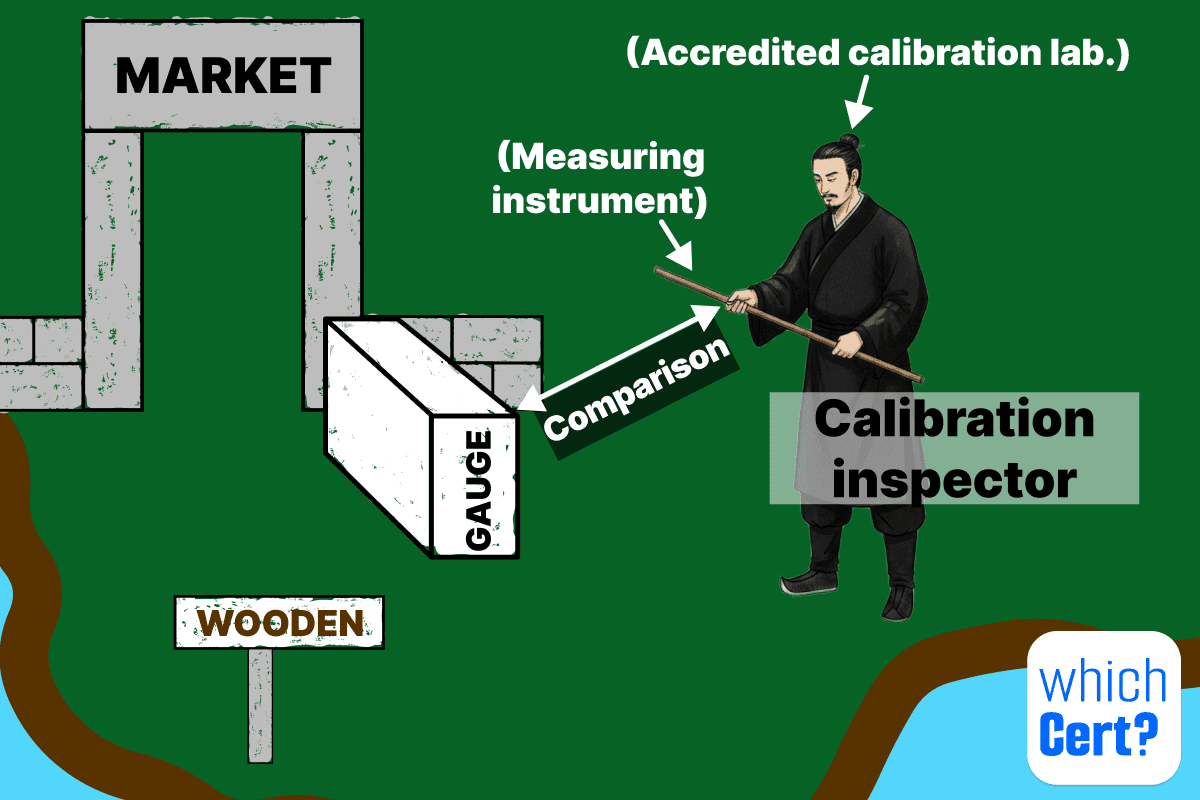
The calibration inspector validates the measurement sticks at the entrance of the market, using his gauge (a rock) as the reference.
The wooden sticks used by merchants to measure lengths are like measuring instruments. However, the calibration inspector at the market entrance is like calibration laboratories, checking that merchants’ sticks match the official rock.
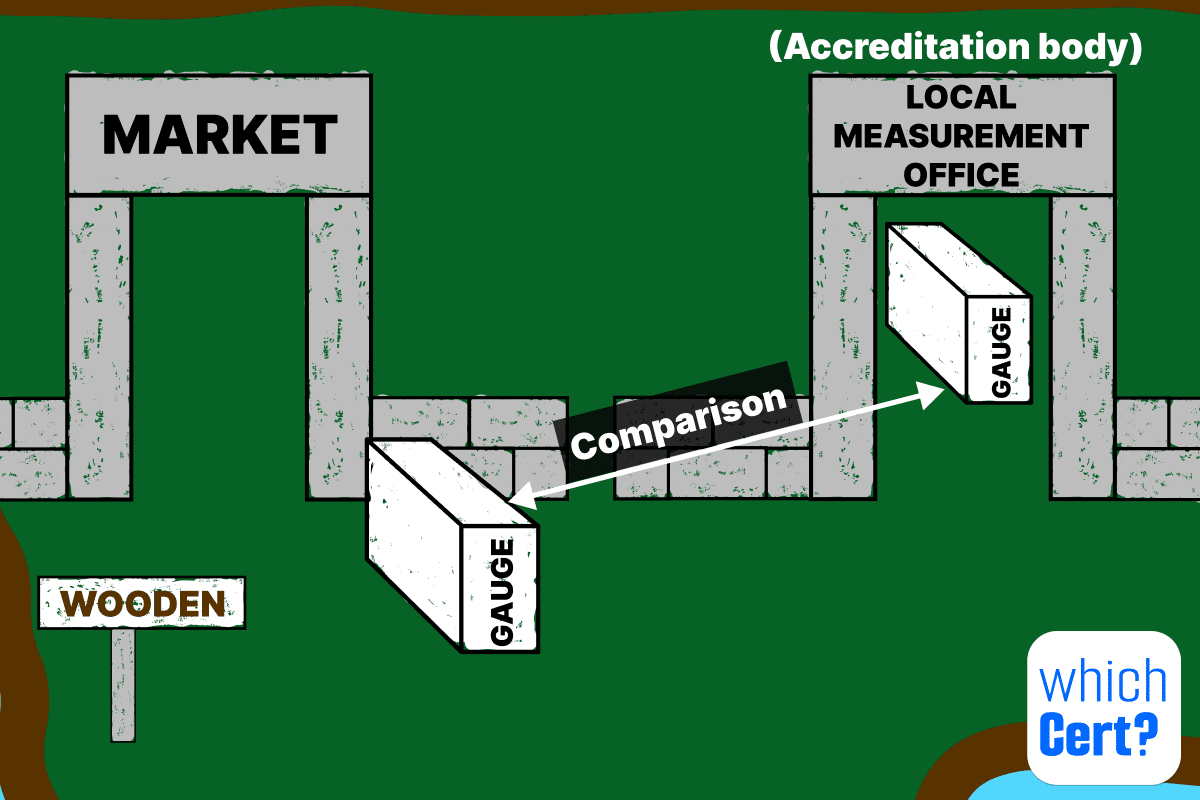
The local measurement office inspects the gauge used by the calibration inspector in the market to ensure it has the same length as their reference gauge.
The local measurement offices in each village are like accreditation bodies, making sure every calibration inspector follows the same reference.
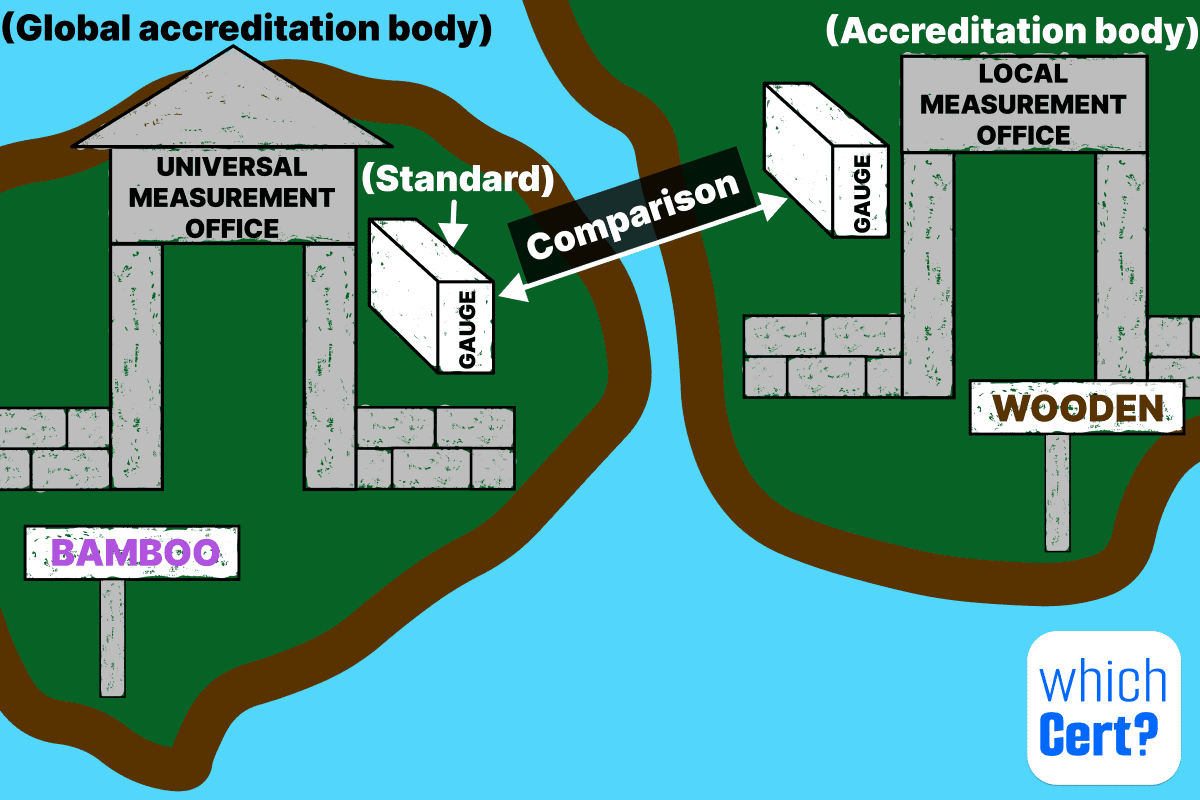
The universal measurement office verifies that the gauges in each village match exactly the length of its reference gauge.
Bamboo village’s “Universal Measurement Office” is like the global accreditation body, ensuring all villages maintain a reliable and consistent “rock” which is the standard to follow.
Why this story? where is certification?
Calibration is the process of certifying measurement instruments, ensuring they produce accurate and reliable results. Similarly, the certification of people or management systems follows the same structured approach as the calibration accreditation system.
Accreditation originally focused on measurements because the need for precise and trustworthy measurements was often more critical—and sometimes even a matter of safety—than verifying professional qualifications.
What are the different types of certification?
There are several types of certification, with the most popular ones listed below:
| Type of Certification | Examples | Bodies / Providers |
|---|---|---|
| Calibration of Measurements | Scales, ultrasonic thickness gauge, sonometer, thermometer | Calibration labs, metrology labs, ISO/IEC 17025 accredited labs |
| Certification of Products / Services | Halal, Kosher, FDA, CE marking | Product certification bodies, notified bodies, regulators |
| Certification of People | CompTIA, Six Sigma, CQI IRCA Lead Auditor | Professional exam providers, certification bodies |
| Certification of Management Systems | ISO 9001, GMP, API Q1, ISO 27001, ISO 45001, ISO 42001, ISO 14001 | ISO certification bodies accredited under ISO/IEC 17021 |
What is an example of accreditation?
For example, this is ISO 9001 accreditation system:
ISO 9001 certification is offered worldwide by accredited certification bodies.
Each certification body is accredited by at least one accreditation body—for example, UKAS in the UK, COFRAC in France, and ANAB or IAS in the US.
Every accreditation body is a member of the International Accreditation Forum (IAF).
Is it applicable to Google, Cisco and AWS certifications?
Yes, it is universal, but for company-specific certifications, the companies themselves usually don’t let other organizations offer their certifications. In these cases, the accreditation body and the certification institute are the same—for example, Google, AWS, or Cisco.
Exception to the rule: Six Sigma accreditation system
Some certifications such as Six Sigma doesn’t have a clear accreditation framework. Hence, there isn’t a single global body for Six Sigma accreditation like ISO’s International Accreditation Forum (IAF). Instead, several independent organizations offer their own Six Sigma certifications.
There are also respected institutions that offer Six Sigma certification programs without formal accreditation.
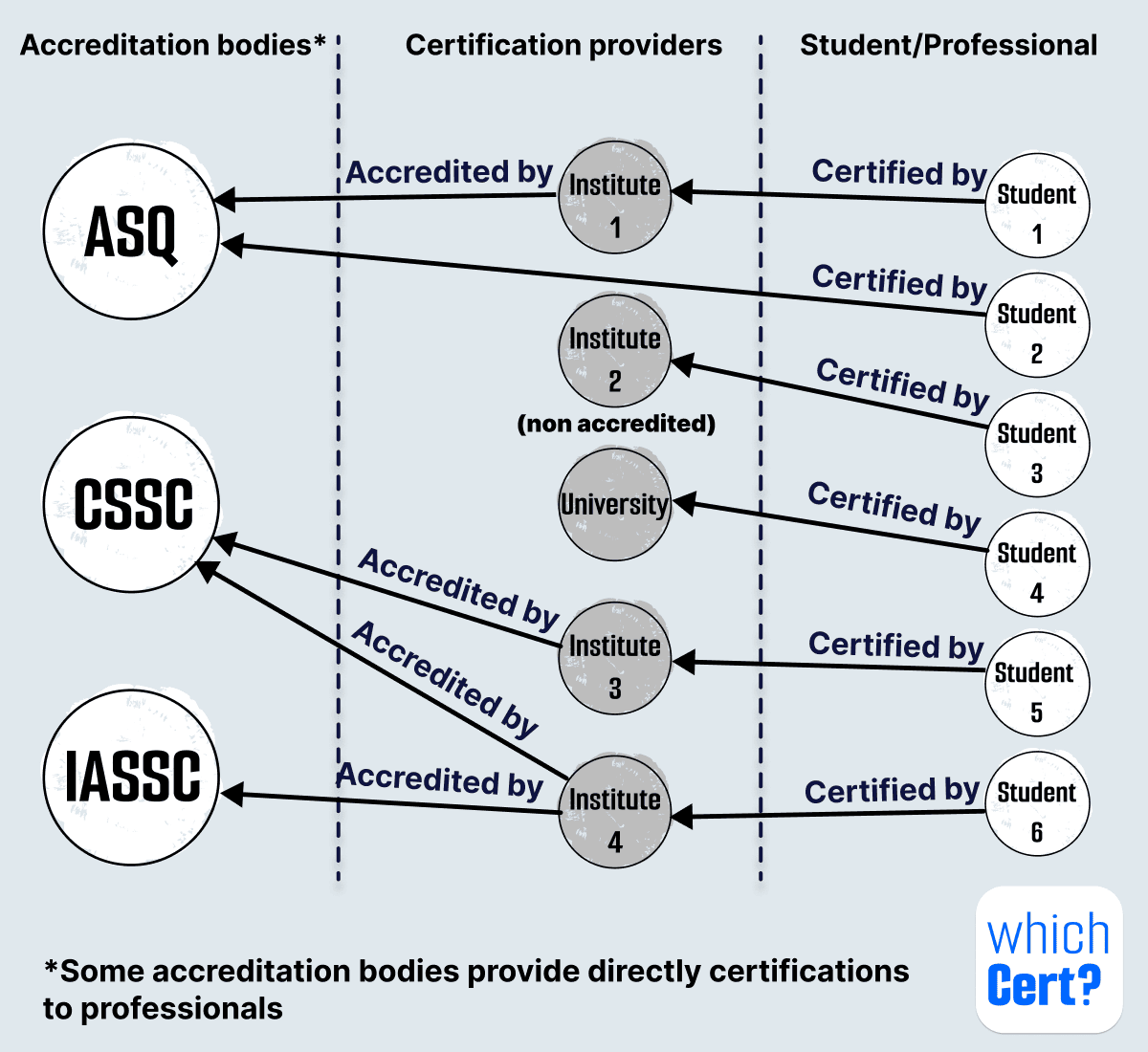
Read our 5-step guide to learn how to earn a recognized Six Sigma certification.
Final thoughts
Accreditation is the main source of credibility for any conformity assessment, including certification of people, management systems, or calibration of measurement tools.
Use WhichCert.com to explore and choose the best certification for you or your organization.
FAQ
What do you mean by accreditation?
Accreditation is the process of verifying that an organization is competent to carry out certification, calibration, or other conformity assessment activities.
What is accreditation in university?
Accreditation of universities differs from the accreditation of conformity assessment activities (which is outside the scope of WhichCert.com). For more information, visit Wikipedia: Educational accreditation.
What is the purpose of accreditation?
The purpose of accreditation is to ensure that organizations conducting conformity assessments—such as certification of people, certification of management systems, or calibration of measurement instruments—are competent to do so.